Producing an award-worthy cinematic short film in September 2026 no longer requires months of development hell, grant bureaucracy, or €25,000 budgets for lighting trucks and camera packages. Today, a solo director can write, direct, score, and deliver a complete 3-to-5-minute narrative short film in a single 48-hour weekend for under €90 in cloud GPU compute. The secret is abandoning disjointed "random prompting" in favor of an integrated circular production pipeline: decomposing scripts into 12 anchor shots in Story Lab, locking character identity sheets (@Hero), rendering with 30-second spatio-temporal diffusion (Seedance 2.0 IR2V & Wan 3.0), generating contact-aware neural Foley sound design, and mastering in 4K on DaVinci Resolve.
Technical Definition: Solo AI Narrative Filmmaking
Solo AI Narrative Filmmaking is the end-to-end creative engineering discipline in which a single filmmaker acts simultaneously as screenwriter, cinematographer, gaffer, actor director, sound designer, and editor using orchestrated generative artificial intelligence models. Unlike unstructured AI clip montages, professional generative short films in 2026 rely on Diffusion Transformers (DiT) conditioned on multi-modal photometric anchors, strict wardrobe and biometric consistency, calibrated 35mm optical anamorphic geometry, and high-fidelity multi-stem audio blending expressive dramatic voice synthesis with physical neural contact Foley.
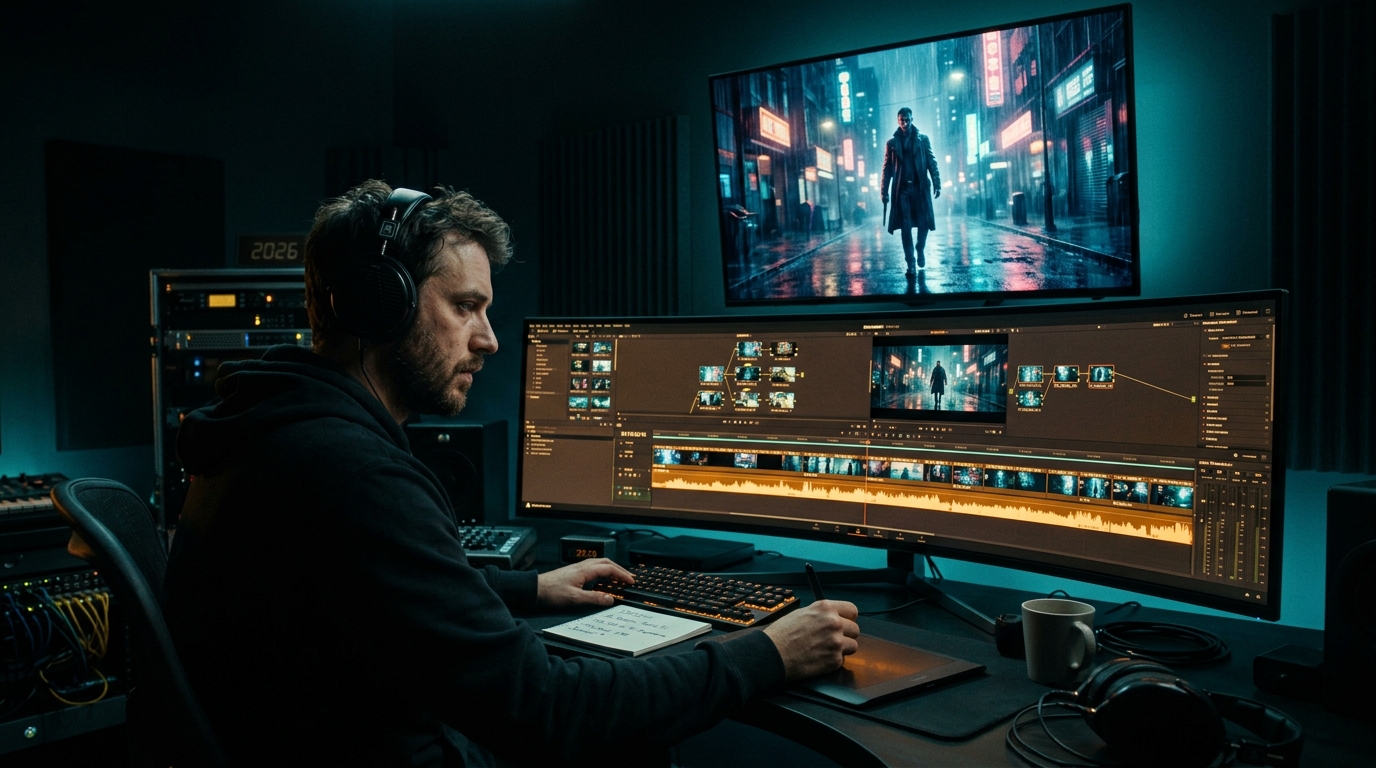
1. The Death of Hollywood Bureaucracy: Why 2026 Is the Golden Age for Solo Directors
When I first began stress-testing generative video diffusion models back in 2024, assembling a coherent film was an exercise in pure frustration. Hands melted into objects, faces morphed between angles, and 3-second clips looked like dreamscapes rather than deliberate cinema. Back then, traditional industry skeptics smirked: "AI is neat for weird GIFs and music video visualizers, but it will never replace the deliberate intentionality of narrative storytelling."
Two years later, in September 2026, that skepticism has evaporated. Complete narrative short films created entirely by individual directors are competing on equal terms at the Runway AI Film Festival and screening at Cannes Next. Not because AI became magic, but because our methodology evolved from haphazard prompting into structured, directed filmmaking pipelines.
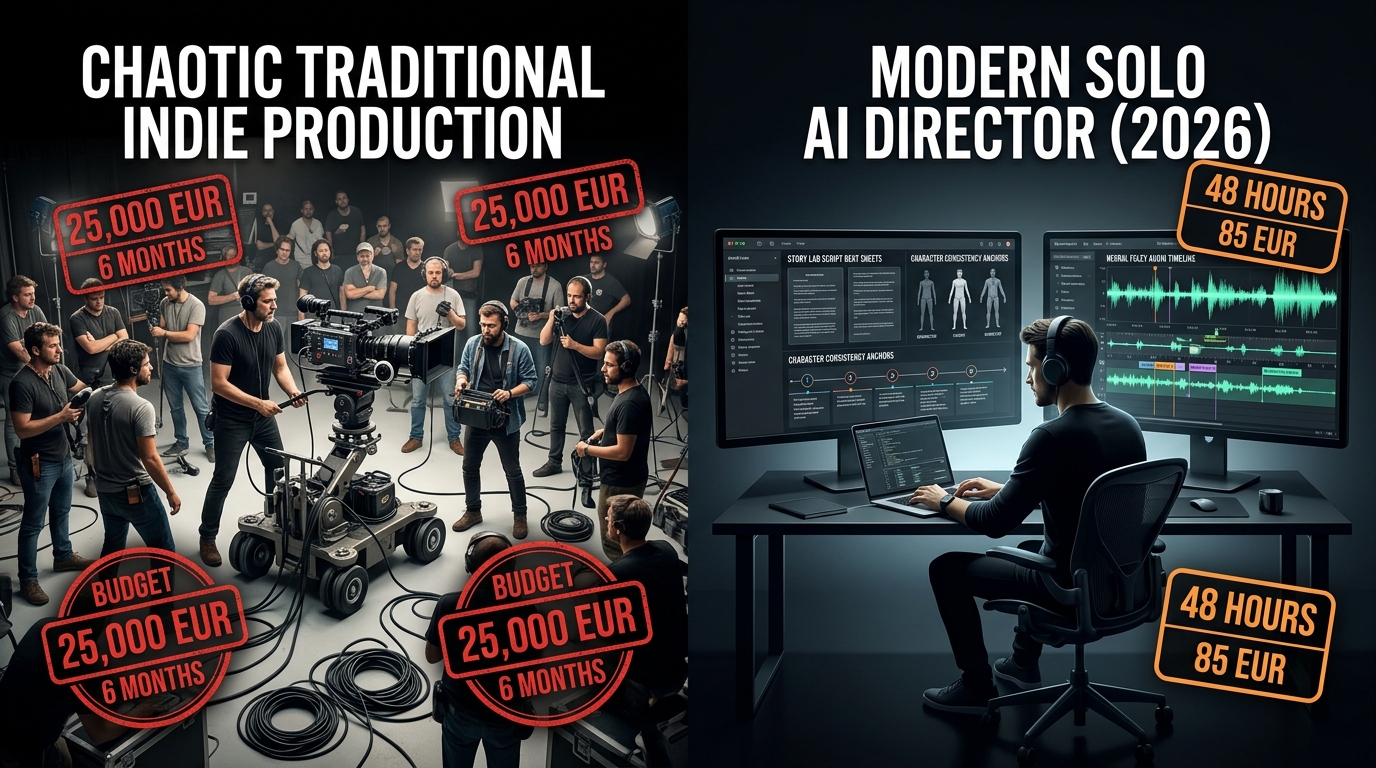
The legacy model for indie short filmmaking is economically obsolete. A standard 4-minute indie short traditionally demanded:
- Soul-Crushing Waiting Cycles: 6 to 12 months waiting for regional arts council grants or crowdfunding rounds to clear.
- Heavy Logistical Drag: €18,000 to €35,000 burned on catering, insurance binders, location permits, generator rentals, and ARRI/RED camera packages.
- Creative Dilution: The director's original vision compromised by fading daylight, lost shooting permits, or unavailable lead actors.
With the modern AI stack, the director reclaims total creative sovereignty. If your scene demands a desperate foot chase through a rain-drenched Kowloon alleyway under neon signs, you don't need municipal permits or €80,000 rain rigs. You can materialize the exact camera move, anamorphic bokeh, and actor intensity on a Saturday afternoon.
2. The 48-Hour Execution Roadmap: From Friday Night Brainstorm to Sunday Night Master
The primary trap amateur creators fall into is generating video clips without a strict storyboard constraint. They blow hundreds of credits on cool-looking shots that cannot be edited together into a coherent story. To deliver a festival-ready short in 48 hours, adhere to this precise schedule:
Phase 1: Screenplay & Story Lab Breakdown (Friday, 8:00 PM – 2:00 AM)
Duration: 6h • Compute: ~€2Never attempt a 30-minute epic for your first solo weekend. The sweet spot for festival impact and YouTube retention is 3 to 5 minutes (approx. 20 to 28 shots total). In Story Lab, break your concept down using the 12 Anchor Shot Rule:
- Act 1 (Shots 1–3): World-building establishment, protagonist's core dilemma, and inciting incident.
- Act 2A (Shots 4–6): Conflict escalation and initial physical/emotional obstacles.
- Midpoint (Shot 7): The major plot revelation or perspective reversal.
- Act 2B (Shots 8–10): Climax buildup, loss of control, and race against the clock.
- Act 3 (Shots 11–12): High-stakes emotional climax and thematic resolution.
Filipe's Pro Tip: Write shot descriptions using tangible physical verbs and lighting vectors rather than emotional musings. Video diffusion engines respond to physical actions ("he runs through driving rain clutching a glowing artifact"), not internal state ("he feels haunted by regret").
Phase 2: Digital Casting & Actor Anchor Sheets (Saturday, 8:00 AM – 1:00 PM)
Duration: 5h • Compute: ~€8The flaw that ruins 95% of amateur AI films is "identity drift": in shot 1 the hero has stubble and deep blue eyes; in shot 2 his jawline has completely shifted.
To solve this once and for all, open the Characters Studio and build an immutable @Hero identity sheet with NanoBanana 2 (GPT-2 Image model). Generate 4 mandatory perspectives:
- Neutral frontal view in flat studio lighting (no heavy shadows to lock the raw facial mesh).
- 45-degree three-quarter profile wearing the hero wardrobe.
- High-tension expression (grit, rage, or pain) to train facial fidelity under muscle stress.
- Full-body wide plate capturing clothing fabric texture, distressing, and signature accessories.
These 4 assets act as the persistent biometric DNA injected into every subsequent video prompt.
Phase 3: Scene Directing & Video Diffusion (Saturday, 2:00 PM – 10:00 PM)
Duration: 8h • Compute: ~€45This is the creative core of the weekend. Inside the Video Studio, assign the best model engine to each specific scene:
- Seedance 2.0 IR2V (Image-Reference-to-Video): The premier engine for dramatic character-driven scenes. Feed your @Hero anchor plate as the starting frame and describe precise camera moves and lighting behavior. Generates up to 15 seconds of clean, consistent acting.
- Wan 3.0 / Kling 3.0 Omni: Ideal for fast kinetic action, vehicle chases, and complex particle physics (pyrotechnics, shattered glass, water splashes).
- Handoff Continuity Protocol (opensOn = closesOn): For sequential continuous scenes over 10 seconds, extract the final clean frame of shot A and inject it as the first frame of shot B. This prevents sudden posture snapping and lighting shifts.
Phase 4: Expressive Voice, Neural Foley & Score (Sunday, 8:00 AM – 2:00 PM)
Duration: 6h • Compute: ~€18George Lucas famously observed that "sound is 50 percent of the moviegoing experience." In AI cinema, I argue sound is 70 percent of visual credibility. If your image has slight synthetic artifacts but the sound design is thunderous, dynamic, and physically grounded, the human brain accepts the scene as real.
In the Audio Studio and Music Studio, we construct sound across 3 dedicated layers:
- Expressive Voice Acting via MiniMax TTS: Tune emotional parameters for breathless urgency, quiet grief, or dramatic shouting. Eliminate robotic cadence by adding natural breathing and hesitations.
- Neural Foley V2A (Video-to-Audio): Synthesize precise footfalls in mud, heavy leather jacket creaks, rain on windshields, and synchronized body impact audio.
- Original 3-Act Cinematic Score: Using Suno 5.5, compose an evolving hybrid orchestral score (dark cellos, industrial modular synths, and 40Hz sub-bass braams) with tonal transitions matching your script's dramatic turning points.
Phase 5: Final Editorial Assembly, Color Grading & 4K Mastering (Sunday, 2:00 PM – 8:00 PM)
Duration: 6h • Compute: ~€12With all video and audio stems rendered, bring the project into DaVinci Resolve or Adobe Premiere. Apply these high-end finishing touches:
- Kill the Plastic AI Look: Overlay genuine 35mm analog film grain (Kodak 500T scan) at 20% opacity and introduce subtle edge chromatic aberration to disrupt synthetic perfection.
- Unified Film Print LUT: Apply a single print emulation LUT (e.g. Kodak 2383) across the entire timeline to harmoniously bond colors between different generation models.
- Neural 4K Upscale: Use Topaz Video AI or DXBuilder's export suite to render a clean, high-bitrate master at 24 frames per second.
3. Reality Check: Traditional Indie Short Film vs 2026 Solo AI Pipeline
To understand the magnitude of this industry shift, examine this head-to-head breakdown for a standard 4-minute narrative short film featuring 2 actors and 2 locations:
| Production Benchmark | Traditional Indie Production | 2026 Solo AI Pipeline |
|---|---|---|
| Total Cash Budget | €18,000 – €35,000 (catering, gear, crew day rates, permits) | €70 – €95 (cloud GPU credits on DXBuilder) |
| Crew Size | 15 to 25 specialists (camera, audio, lighting, hair/makeup) | 1 Solo Director (supported by AI agent studios) |
| Delivery Timeline | 4 to 9 months (grant cycles, scheduling, physical shoot) | 48 Hours (Friday evening to Sunday evening) |
| Weather & Location Control | Subject to weather cancellations, permit issues, noise bleed | 100% Deterministic (torrential neon storms, deep space, historical) |
| Reshoot Cost Per Shot | €2,500 – €6,000 (rebooking crew, actors, and stages) | €0.40 (regenerating a 15-second take in 45 seconds) |
| Intellectual Property Ownership | Divided between grant bodies, executive producers, and distributors | 100% Retained by the Independent Filmmaker |
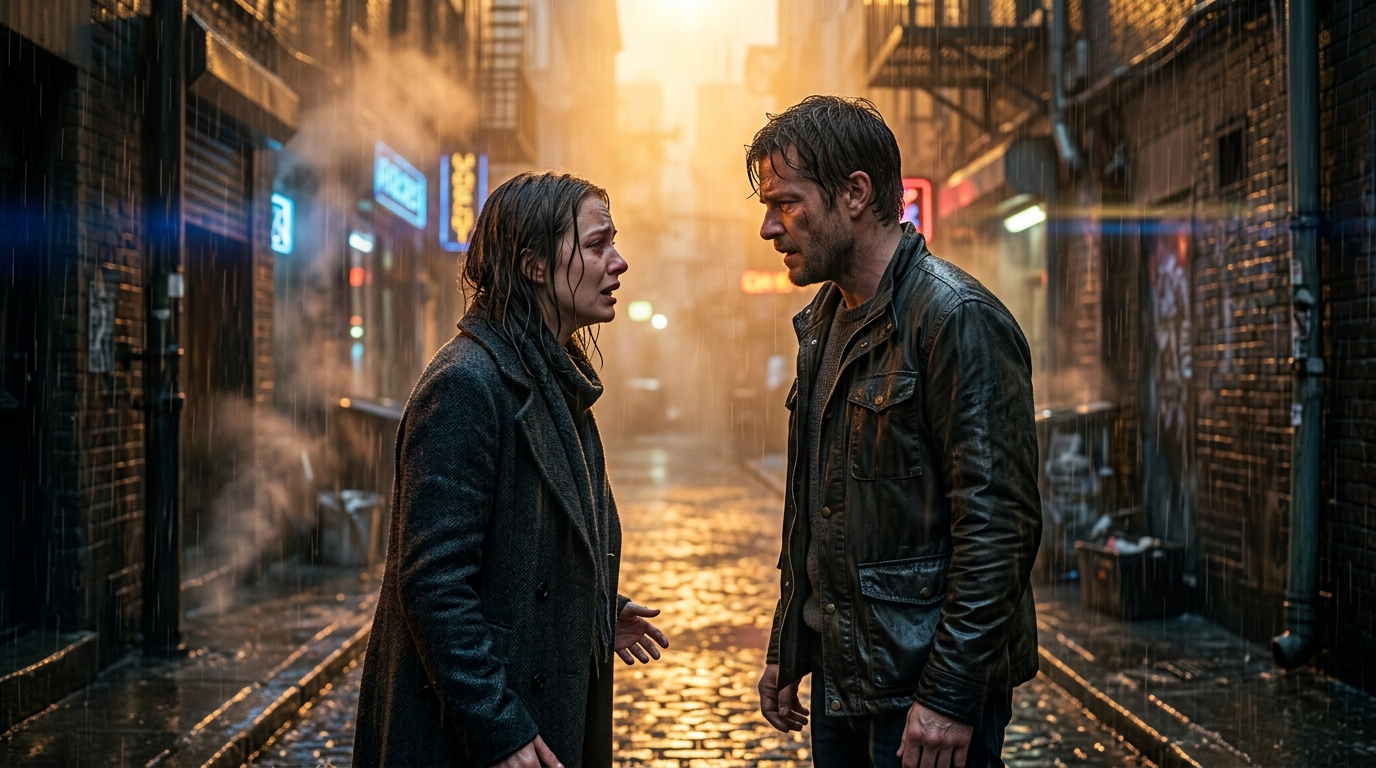
4. Three Cinematic Prompt Formulas That Eliminate Plastic AI Looks
The reason most AI videos online look artificial and forgettable is the complete lack of cinematographic optical physics in user prompts. Typing "a man crying in a dark alley 8k photorealistic" produces synthetic sludge. A diffusion transformer requires optical parameters: lens focal length, aspect ratio, lighting ratio, and camera velocity.
Here are 3 production-tested formulas from my own DXBuilder workflow ready to copy and adapt:
Cinematic extreme wide master shot establishing a deserted neo-noir metropolis at 3 AM during a heavy downpour, shot on ARRI Alexa 65 with 24mm Panavision anamorphic lens. Volumetric golden-amber (#FF9B3E) sodium streetlamps reflecting on flooded asphalt puddles, deep cyan shadows in misty alleyways. Slow atmospheric crane down movement, physical rain particle splashes, authentic 35mm film grain, low key chiaroscuro lighting, 8k cinematic masterpiece, no cartoon, no CGI over-smoothing.
Why it works: Explicitly designating "ARRI Alexa 65 with 24mm Panavision anamorphic lens" commands the diffusion network to simulate horizontal lens flares, oval bokeh, and subtle edge distortion, eliminating flat CGI rendering.
Dynamic medium tracking shot of @Hero running desperately through a crowded futuristic night market, dodging neon stalls and wet umbrellas. Kinetic handheld camera movement with subtle natural operator vibration, natural motion blur on background elements while keeping @Hero face sharp and consistent. Raindrops dripping from soaked wool coat collar, sudden horizontal gold streak lens flare as he crosses a motorcycle headlight, 24fps film cadence, high kinetic energy.
Why it works: "Subtle natural operator vibration" and "natural motion blur on background while keeping face sharp" simulates a real Steadicam operator following talent with a 180-degree physical shutter.
Intense dramatic tight close-up shot of @Hero reacting to a devastating revelation, shot on 85mm prime lens at f/1.4. Extremely shallow depth of field with creamy background bokeh. Micro-tremble in eye muscles, subtle breath vapor in cold night air, realistic human skin pores with sweat and translucent subsurface scattering, warm key light catching tear in right eye. No airbrushing, no plastic sheen, authentic raw emotional acting, 8k photorealistic cinema still.
Why it works: Calling for "translucent subsurface scattering" instructs the network to simulate light penetrating human skin and scattering internally, destroying the infamous "airbrushed mannequin" look.
5. Distribution & Monetization: AI Film Festivals, Brand Commercials, and YouTube
Rendering the final video is only half the journey. The objective of an ambitious solo filmmaker in 2026 is converting that 4-minute short into commercial client contracts, studio meetings, or feature film financing. Here are the 3 proven revenue paths:
- AI Film Festival Circuits: Enter premier competitions including the Runway AI Film Festival, Cannes Next GenAI Showcase, and Tribeca X. Official selection immediately puts you on the radar of talent agencies and production companies searching for directors fluent in synthetic pipelines.
- High-Ticket Commercial Portfolio: A narrative sci-fi or period drama short film is the ultimate proof that you can deliver luxury brand commercials for fashion houses, automotive brands, or gaming studios for €5,000 in 72 hours—undercutting €60,000 agency bids while delivering superior visual spectacle.
- Viral YouTube Launch with Behind-the-Scenes Breakdown: Don't merely upload the film; publish a companion 10-minute video explaining how you pulled it off in 48 hours. "How I Made a Sci-Fi Movie in 48 Hours Alone" videos command astronomical CTR, high retention, and lucrative brand sponsorships.
6. Frequently Asked Questions: Solo AI Filmmaking in 2026
How much does it genuinely cost to make a complete AI short film in 2026?
For a focused, well-planned 25-shot narrative film running 3 to 4 minutes, total compute expenditure typically lands between €65 and €95 on DXBuilder. This covers story breakdown (~€2), character anchor sheets with NanoBanana 2 (~€8), multi-shot scene diffusion with Seedance 2.0 & Wan 3.0 (~€45), expressive voice synthesis & neural Foley (~€18), and final 4K neural export (~€10).
How do I maintain perfect actor face consistency across every shot?
The secret is generating a 4-perspective biometric anchor sheet upfront in Characters Studio. When you inject your @Hero anchor into Seedance 2.0 IR2V (Image-Reference-to-Video), the model tracks 3D spatial facial geometry, preserving bone structure, gaze, and skin tones regardless of camera angle or dramatic lighting.
Do mainstream film festivals accept AI-generated short films?
Yes. Major festivals including Tribeca, Sundance, SXSW, and Annecy now feature official competitive tracks for AI-augmented and synthetic cinema. In addition, dedicated competitions like the Runway AI Film Festival award over $100,000 in cash prizes annually for original narrative works.
Do I need an expensive multi-GPU workstation to direct this?
No. All heavy spatio-temporal diffusion, voice cloning, and neural Foley synthesis runs remotely on DXBuilder's cloud GPU clusters. You can direct an entire production from an everyday laptop or tablet—you only need an internet connection and free editing software like DaVinci Resolve for final assembly.
About the Author: Filipe Heitor
Founder and Creative Director of DXBuilder. Digital filmmaker, spatio-temporal diffusion architect, and passionate advocate for independent storytelling unburdened by Hollywood red tape. I believe the next cinematic milestone will not emerge from a legacy studio lot, but from a determined director's bedroom armed with the right creative tools.