Decision Matrix: Who It’s For (And Who Should Skip)
| Ideal for (Best for) | Skip or wait if |
|---|---|
| DTC e-commerce brands, growth agencies, and creators needing full 30-second video commercials for Reels, TikTok Shop, and YouTube without paying $4,000+ to physical production crews. | Simple projects that only need a brief 2-second looping static logo animation for an enterprise homepage. |
| Independent filmmakers and commercial directors wanting smooth continuous camera tracking shots, orbital moves, and narrative continuity without visual glitches. | Teams who still type vague generic text prompts into video models expecting the AI to guess product packaging, lighting, and lens physics without an anchor reference. |
| Video editors and marketers looking to eliminate 80% of post-production friction by receiving synchronized native sound effects and Foley directly with the render. | Operators who still believe downloading 120GB of local model weights to power-hungry local desktop GPUs is more economical than using cloud-accelerated web suites. |
What Changed in 2026: Why 5-Second Video Clips Became Obsolete
Until recently, creating video ads with generative AI was a frustrating, disjointed process: models were fundamentally capped at 4 or 5 seconds. To build a standard 30-second commercial, creators had to generate half a dozen disconnected clips and attempt to stitch them together in post-production. The result was inevitable: the character's facial features drifted, product logos melted, the background warped, and lighting flickered violently across cut points.
In October 2026, generative video diffusion reached a milestone: native unbroken 30-second continuous generation. Leading models such as Seedance 2.5 (ByteDance), Kling 4.0 Flash (Kuaishou), and Wan 3.0 (Alibaba) leverage Diffusion Transformers (DiT) with extended temporal attention windows that lock physics, camera trajectory, and character identity across all 30 seconds.
Seedance 2.5 IR2V
The gold standard for commercial product videos and multi-reference consistency. Allows input of up to 3 anchor references (product, actor, and environment), ensuring typography, material textures, and facial likeness remain mathematically locked for all 30 seconds.
Kling 4.0 Flash
Top-tier performance in 4K HDR with 10-bit color depth and control over up to 10 keyframe anchors. Creators can direct intricate camera trajectories specifying exactly where the camera glides at seconds 0, 10, 20, and 30.
Wan 3.0 Video
Exceptional for fluid dynamics, realistic natural environments, and complex physics. Masters outdoor wide shots of urban metropolises, moving crowds, and optical light refraction through water and rain.
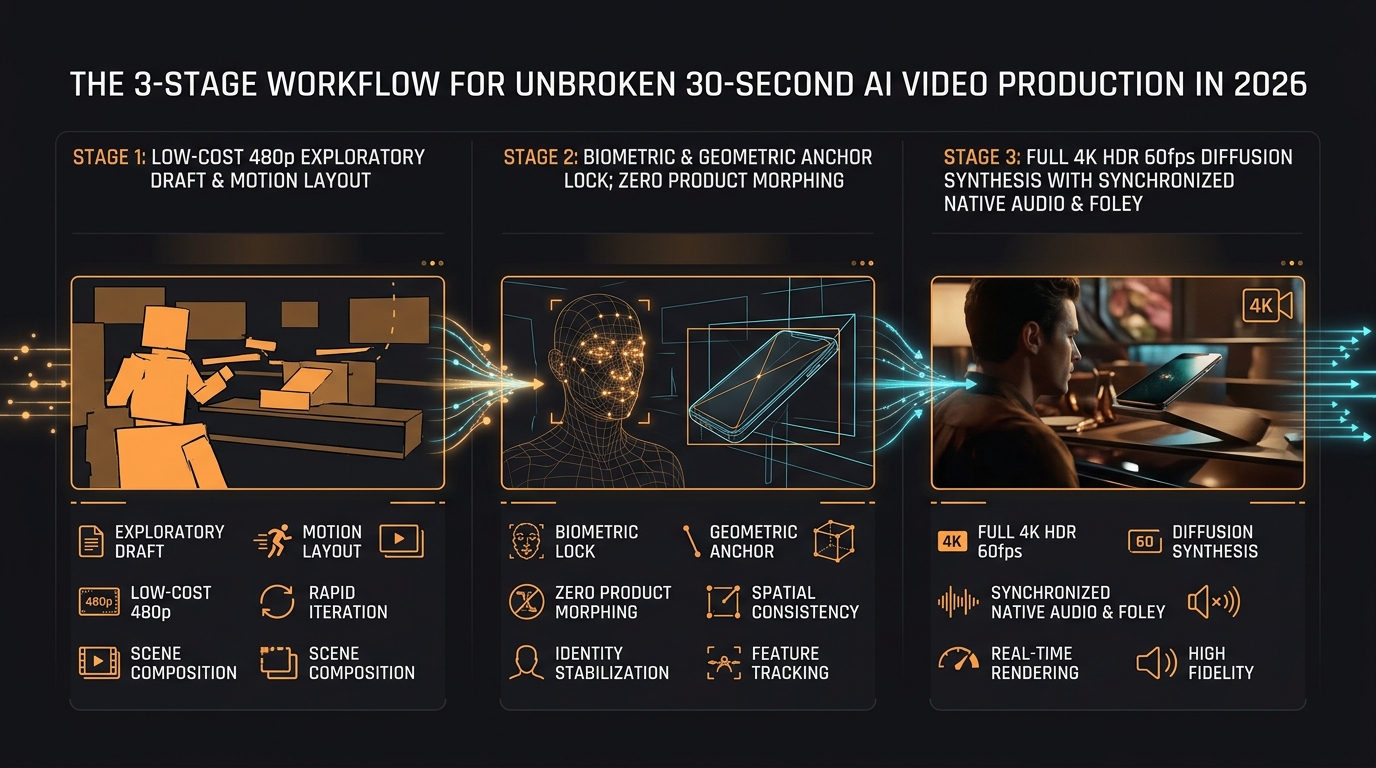
The Production Blueprint: The 3-Stage Workflow for Flawless 30s Videos
Novice creators often jump into an AI tool and immediately hit "Render 4K 30s" from raw text. This burns credits, takes minutes to generate, and often misses the desired composition. In DXBuilder, professional studios execute a structured 3-stage pipeline:
Stage 1: Low-Cost Motion Layout (480p Draft)
Before investing in high-resolution compute, validate camera choreography and pacing. In DXBuilder, you can generate an exploratory 480p draft in under 10 seconds. Check whether an orbital rotation, a forward dolly, or an overhead crane shot looks best. If the trajectory is right, advance to Stage 2; if not, tweak your motion prompt instantly without wasting budget.
Stage 2: Anchor Keyframe Lock (Zero Morphing Protocol)
This is the secret that separates hobbyists from professional agencies: never rely on pure Text-to-Video for commercial products or recurring characters. First, generate a pristine photographic still in DXBuilder's image studio (using Nano Banana 2 or GPT2). This anchors packaging typography, logos, and biometric facial symmetry. The video diffusion engine then treats this keyframe as a non-negotiable geometric constraint.
Stage 3: Full 30s 4K Diffusion with Synchronized Native Audio
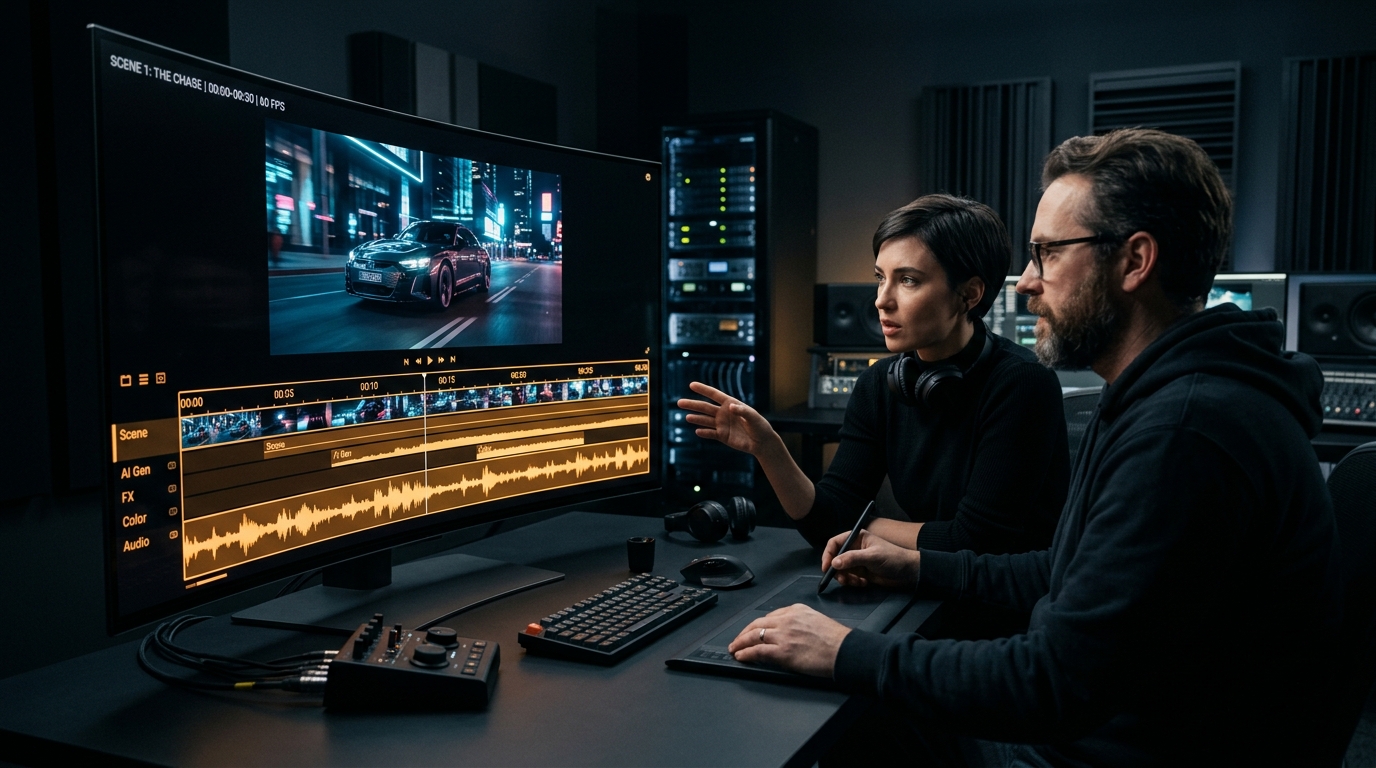
Feed your approved motion vectors and anchor keyframe into Seedance 2.5 IR2V. The engine synthesizes the unbroken 30-second sequence with volumetric lighting and physical particle dynamics, while generating synchronized native Foley (liquid pouring, tires rolling over rain, or echoing footsteps) right into the media stream.
Technical Specifications: 30-Second Video Engines (October 2026)
Comparative benchmarks measured inside DXBuilder's live production infrastructure:
| Engine / Model | Max Native Duration | Max Resolution | Native Audio | Object Stability | Render Time (30s) |
|---|---|---|---|---|---|
| Seedance 2.5 IR2V | 30s unbroken | 4K UHD (60fps) | Yes (Foley + SFX) | 9.9 / 10 (Multi-Ref) | ~45 seconds |
| Kling 4.0 Flash | 30s unbroken | 4K HDR (10-bit) | Yes (Stereo Ambience) | 9.5 / 10 (10 Keyframes) | ~60 seconds |
| Wan 3.0 Video | 30s unbroken | 2.5K QHD | Partial (Basic) | 9.1 / 10 (Fluid physics) | ~75 seconds |
| MiniMax H3 Turbo | 15s - 20s | 1080p FHD | Yes (Voice + Foley) | 8.8 / 10 (High speed) | < 15 seconds |
3 Production-Ready Prompt Formulas for Unbroken 30s Videos
Battle-tested formulas engineered to deliver maximum visual fidelity and narrative pacing in the DXBuilder video studio:
Keyframe Anchor: "Ultra-sharp commercial studio still of a luxury matte dark bottle of cold-brew coffee sitting on a wet granite pedestal, golden amber backlight (#FF9B3E), tiny condensation droplets on the glass, razor-sharp 85mm lens, 8k resolution."
30s Motion Prompt: "Continuous unbroken 30-second camera sequence: Camera starts in an extreme macro close-up of condensation droplets sliding down the glass, slowly pulling back into a sweeping 360-degree orbital rotation while fresh roasted coffee beans tumble past in gentle slow motion. Lighting shifts smoothly from cool morning daylight to warm golden amber sunset. Native crisp sound of glass clinking, liquid pouring, and subtle studio ambience."
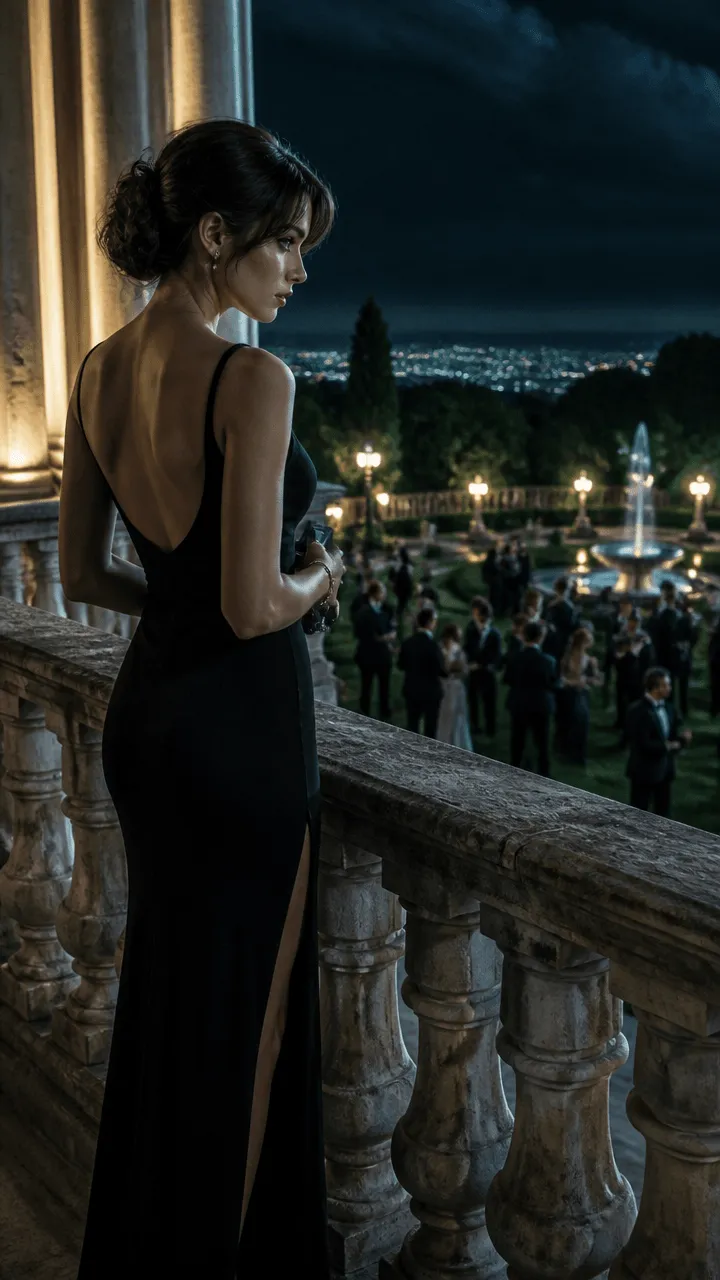
Keyframe Anchor: "Cinematic anamorphic still of a female researcher in a dark illuminated laboratory looking at a floating holographic energy sphere. 35mm lens, subtle optical flares, authentic skin textures, cool teal background with warm amber rim light."
30s Motion Prompt: "Unbroken 30-second continuous dolly shot: Camera glides slowly past glass servers and monitors towards her face as the holographic core expands and pulses with particle rings. She reaches out with her gloved hand at second 18, causing gentle light ripples to wash across her face. Realistic low hum of high-voltage machinery, synthetic electrical pulses, and gentle room reverb."
Keyframe Anchor: "First-person smartphone POV shot holding an ultra-sleek mechanical titanium pen over an open architectural sketchbook on a sunlit wooden desk. Crisp natural lighting, sharp focus on hands."
30s Motion Prompt: "Seamless 30-second first-person sequence: Hand unboxes the titanium pen, clicks the magnetic cap with a satisfying mechanical snap at second 4, smoothly draws a blueprint line across the paper while the camera shifts angle to reveal a 3D isometric sketch emerging from the page. Authentic tactile paper friction sounds, crisp metallic clicking, and natural ambient room audio."
Real Frequently Asked Questions (People Also Ask)
What is the difference between generating one unbroken 30-second video vs. stitching six 5-second clips? ▼
The difference comes down to latent temporal consistency. When generating separate 5-second cuts, the neural diffusion model re-samples random noise for each prompt, causing subject morphing, altering clothing details, or shifting room dimensions. In a native 30-second generation (like Seedance 2.5), the model maintains the exact same spatial and temporal latent space, ensuring characters and props remain 100% consistent throughout the full take.
What is Image-to-Video anchor conditioning and why is it mandatory for 30s videos? ▼
Anchor conditioning uses a photorealistic keyframe image as frame zero. Rather than asking the AI to hallucinate a product from text descriptions, the model is handed exact dimensions, textures, and typography. The diffusion model then focuses purely on motion vectors and lighting shifts, preventing product deformation.
How does native audio synthesis work alongside video diffusion in 2026? ▼
Modern models use multimodal Audio-Visual Diffusion Transformers that cross-correlate visual pixel movement with acoustic waveforms. As the model synthesizes water splashing or footsteps impacting wood, it generates corresponding audio frequencies in millisecond optical sync, eliminating manual sound design in external editing software.
Do I need an expensive local GPU to create these 30-second videos in DXBuilder? ▼
No. All heavy computation runs on DXBuilder's enterprise cloud clusters powered by dedicated H100 and B200 neural accelerators. You can direct and render broadcast-quality 4K videos from any laptop, tablet, or smartphone directly in your web browser without hardware strain or electricity bills.
Launch Your Production in the DXBuilder Studio Today
Join over 1,500 brands, filmmakers, and creators producing broadcast-grade 30-second commercials with locked geometry and native audio directly in the browser.
Filipe Heitor
Founder & AI ArchitectProduct engineer, filmmaker, and founder of DXBuilder. Specialist in continuous 30-second video diffusion, multimodal audio pipelines, and frictionless generative cinema architectures.