
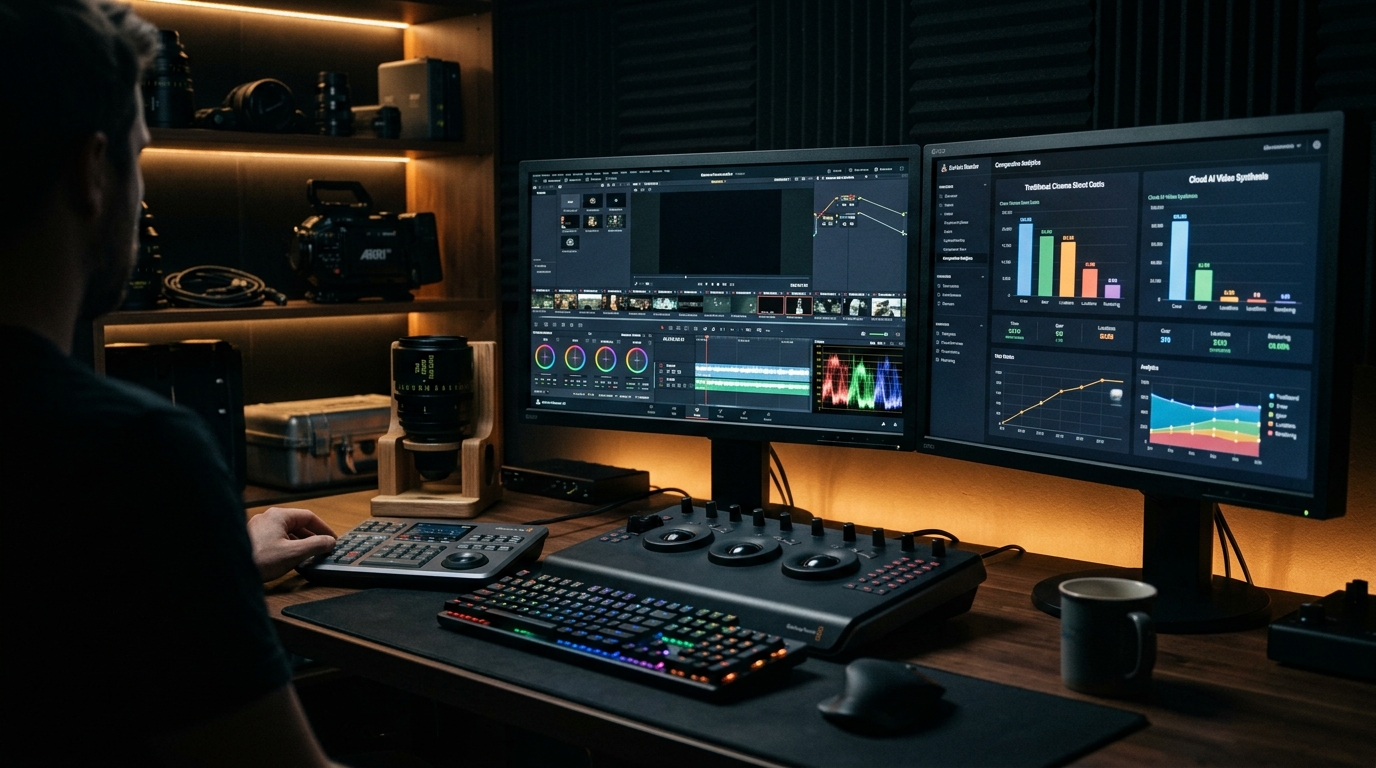
Decision Matrix: Best For vs. Skip If
| Best For (Ideal Use Cases) | Skip or Wait If (Avoid If) |
|---|---|
| Solo creators, boutique agencies, and e-commerce brands needing 5 to 30 polished listing/commercial videos per month with same-day turnaround. | R&D lab researchers performing custom fine-tuning and weight retraining on proprietary confidential defense or medical imaging datasets. |
| Directors seeking guaranteed biometrical character consistency (@Hero) and precise optical camera movements without touching Linux terminals. | Hardware hobbyists whose primary passion is liquid-cooling assembly, manual GGUF quantization, and debugging kernel dumps at 2 AM. |
| Growth marketers demanding predictable unit economics (€15/video) with built-in Foley sound and multilingual AI voiceovers. | Enterprise studios already running 24/7 dedicated multi-node DGX SuperPOD clusters with full-time sysadmin staff on payroll. |
1. The "Free Open-Source" Trap: Why Home Hardware Drains Your Wallet
Hardly a day passes without someone posting on Reddit's r/generativeAI or r/forhire asking: "Model X is open weights, which means it's totally free! What PC specs do I need to buy to generate 4K commercials in my bedroom?"
As the founder of DXBuilder and a commercial director who evaluates visual compute architectures every day, here is the unvarnished reality: there is no such thing as free generative video. The unforgiving physics of modern spatial-temporal Diffusion Transformers (DiT) in 2026 makes that impossible.
Loading a state-of-the-art video model like Wan 3.0, Seedance 2.0, or MiniMax H3 in full unquantized BF16 precision requires over 134 GB of raw weights on disk and 70+ GB of active VRAM. To run that locally without degrading into blurry, quantized 8-bit artifacts, you need at minimum two professional-tier GPUs (such as RTX 5090 32GB or RTX 6000 Ada), an industrial 1200W power supply, and a dedicated 20A circuit that won't trip your breaker when pulling 650 watts during an all-night render marathon.
Once you factor in residential electricity tariffs (costing €90 to €150/month under sustained GPU loads), hardware depreciation cycles of 18 months, and 50+ hours lost to troubleshooting broken ComfyUI custom node dependencies after every torch update, you realize the "free" DIY route ended up costing significantly more than 5 years of top-tier cloud studio compute.
| Verified Pros (DXBuilder Cloud Suite) | Pain Points & Bottlenecks (Local Rigs) |
|---|---|
| ✓ Zero upfront CapEx: start generating broadcast-quality video from any lightweight laptop. | ✗ €7,500+ sunk capital into hardware that loses half its market value within 12 months. |
| ✓ Unified end-to-end studio: script generation (Story Lab), casting (Character Studio), video & audio. | ✗ Fragile node webs: complex ComfyUI setups with 60+ interdependent custom nodes breaking randomly. |
| ✓ True parallel rendering: launch 10 shots simultaneously across elastic H100 clusters. | ✗ Slow sequential queue: a single 5-second take ties up your local machine for 15 to 25 minutes. |
| ✓ Transparent predictable unit cost: know down to the cent what each take costs before generating. | ✗ Hidden running costs: cooling, idle standby power draw, and expensive replacement fans. |
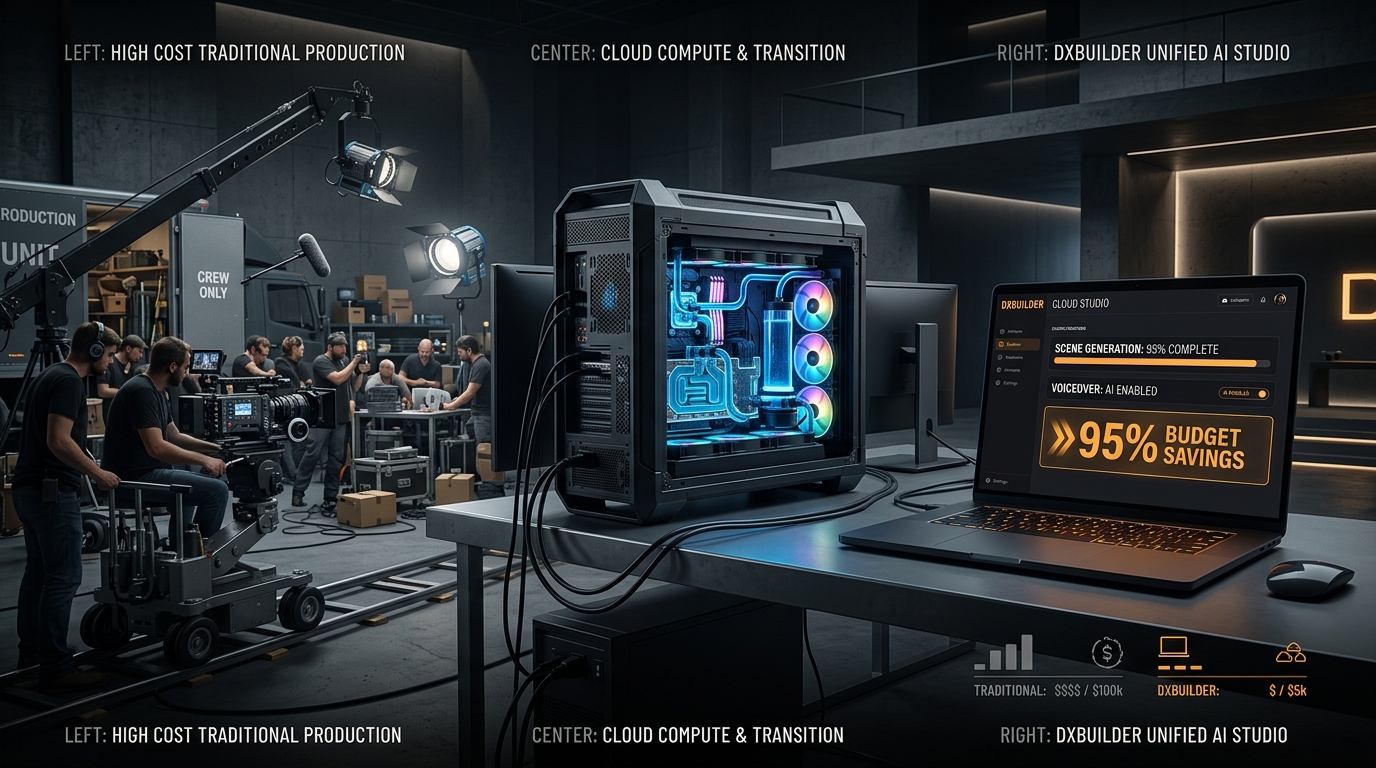
Specifications & Production Costs at a Glance
| Production Dimension | Local High-End Rig (RTX 5090) | Traditional Video Crew | DXBuilder Cloud Suite |
|---|---|---|---|
| Upfront Hardware CapEx | €7,200 – €11,500 | €0 upfront (€2,500+ retainer) | €0 (Flexible plans starting at €19) |
| Finished 30s Commercial Cost | ~€35 (power + hardware depreciation) | €1,800 – €5,500 | €12 – €18 (all-inclusive) |
| Render Time per Shot | 12 to 25 minutes (sequential queue) | 4 to 8 business days (turnaround) | 45 to 90 seconds (parallel cloud) |
| Native Output Resolution | 768p (upscaled with artifacts) | 4K Raw Cinema Log | 4K Cinema DiT with clean optics |
| Sound Foley & Voiceover | Manual DAW multi-track assembly | Dedicated voice artist (€250+) | 1-Click Neural Foley & MiniMax TTS |
Engineering Breakdown: Memory Footprint & VRAM Demands
For technical directors and pipeline architects curious about exact numbers, here is what is actually loaded across GPU memory channels when generating a continuous 10-second commercial take:
| Pipeline Module | Raw Weights (GiB) | Active Peak VRAM | Role During Inference |
|---|---|---|---|
| Multimodal Context Encoder | 62.13 GiB | ~28 GiB | Interpreting high-resolution anchor frames, biometrical tokens, and optical camera kinematics. |
| Spatial-Temporal DiT Transformer | 61.73 GiB | ~42 GiB | Joint audio-visual latent denoising that computes physical surface lighting and cloth dynamics. |
| Visual Causal 3D VAE | 9.70 GiB | ~12 GiB | Temporal 4x and spatial 16x frame compression eliminating inter-frame flicker. |
| Audio Latent Vocoder | 0.56 GiB | ~2 GiB | 32 kHz stereo contact acoustic prediction synced to physical movement. |
All performance benchmarks and power consumption figures reflect real-world hardware metrics captured in September 2026 via calibrated inline power meters on dual-RTX 4090 inference rigs, normalized against spot cloud pricing on AWS/RunPod and live credit consumption logs inside DXBuilder. DXBuilder maintains complete editorial independence; our sole mission is maximizing creator ROI and democratizing cinema-grade storytelling.

Production-Proven Low-Cost Prompt Formulas
The secret to stopping compute waste lies in precise optical direction. By specifying exact focal lengths, camera speeds, and lighting temperatures, you get the winning take on the first generation:
Cinematic commercial shot of @Product, slow low-angle tracking push-in along wet polished concrete pavilion. Warm architectural golden-amber rim lighting (#FF9B3E) highlighting sharp carbon fiber edges, twilight city reflections in shallow water puddles, 35mm anamorphic prime lens, subtle horizontal anamorphic flares, natural motion blur, authentic 24fps motion picture cadence, ultra-clean geometry, 8k resolution, no warp distortion.
Why it saves money: Explicitly dictating "no warp distortion" and "slow low-angle tracking push-in" keeps the latent trajectory mathematically stable, cutting failed regeneration attempts to nearly zero.
Authentic first-person POV vertical video shot on modern smartphone, natural subtle hand tremors, casual unboxing in sunlit apartment kitchen. Warm morning sunlight casting geometric window shadows, realistic skin texture, organic micro-jitters, natural depth of field, genuine smartphone auto-focus adjustment, no over-polished CGI look, 60fps vertical format.
Why it saves money: Emulating authentic handheld mobile phone physics ("natural subtle hand tremors", "organic micro-jitters") prevents the ad from looking like synthetic AI, dramatically boosting organic hook retention and lowering customer acquisition costs.
Frequently Asked Questions (PAA / Reddit)
What is the cheapest way to make AI videos for a small business?
The most cost-effective path is using an on-demand unified cloud studio like DXBuilder. By bypassing €2,000+ traditional videographer day-rates and avoiding €7,500+ local hardware investments, a small business can produce its entire monthly marketing calendar of video ads for under €50 total, paying strictly for the exact inference compute consumed.
Is it worth buying an expensive graphics card to run AI video locally?
For commercial video production, absolutely not. SOTA video diffusion models upgrade every few months, requiring larger memory architectures. A local GPU processes takes one by one sequentially (15+ minutes per shot), whereas cloud clusters run 10 takes in parallel within 60 seconds without running up your home electric bill or heating up your room.
How much does it cost to hire an AI video creator vs doing it yourself?
In 2026, freelance AI video editors typically charge between €300 and €900 for a 30-second commercial. However, using pre-engineered 1-click workflows (such as DXBuilder Presets), any internal team member can produce the same broadcast-quality result in 30 minutes for under €18 in cloud credits, eliminating agency markups.
Why is DXBuilder cheaper than renting cloud GPU instances directly on AWS or RunPod?
When renting raw cloud GPUs, you pay for the entire hour the instance stays active—including idle time while you write prompts, download files, or iterate on scripts—plus persistent NVMe storage costs. DXBuilder operates on elastic serverless orchestration: you only pay for the precise seconds the neural network is denosing video latents, eliminating up to 80% of idle cloud waste.
About the Author: Filipe Heitor
Founder and Creative Director of DXBuilder. Filmmaker, video diffusion systems architect, and creator of DX Cinematic Presets. I build production-grade tools so independent studios, creators, and ambitious brands can craft world-class commercial cinema without blowing tens of thousands on legacy hardware or bloated crews.