Decision Matrix: Who It’s For (And Who Should Skip)
| Ideal for (Best for) | Skip or wait if |
|---|---|
| E-commerce brands, DTC companies, and SaaS founders needing dozens of weekly UGC ad iterations on TikTok, Reels, and YouTube Shorts. | Feature film directors requiring 65mm anamorphic glass, 10-person camera crews, and million-dollar physical studio setups. |
| Performance marketing agencies wanting to crush ad fatigue and lower Customer Acquisition Costs (CAC) with authentic front-camera video clips. | Complex 20-minute physical mechanical tutorials that demand millimeter-precise physical tool interactions. |
| Solo founders who want consistent branded human ambassadors (@Hero) endorsing products without paying upfront influencer retainers or waiting weeks. | Teams insisting on blind one-shot 60-second text prompts without starting from high-resolution photographic reference anchors. |
Why Most AI Videos Look Fake: The Physics of Mobile Phone Cameras
Every single day I watch digital marketers and business owners fall into the exact same trap: they open an AI video generator, type in buzzword-bloated prompts like "hyperrealistic 8k, award winning cinematography, studio volumetric lighting, unreal engine 5 render" and then wonder why the output looks like a synthetic video game cutscene or an overpriced perfume commercial that users swipe away within half a second.
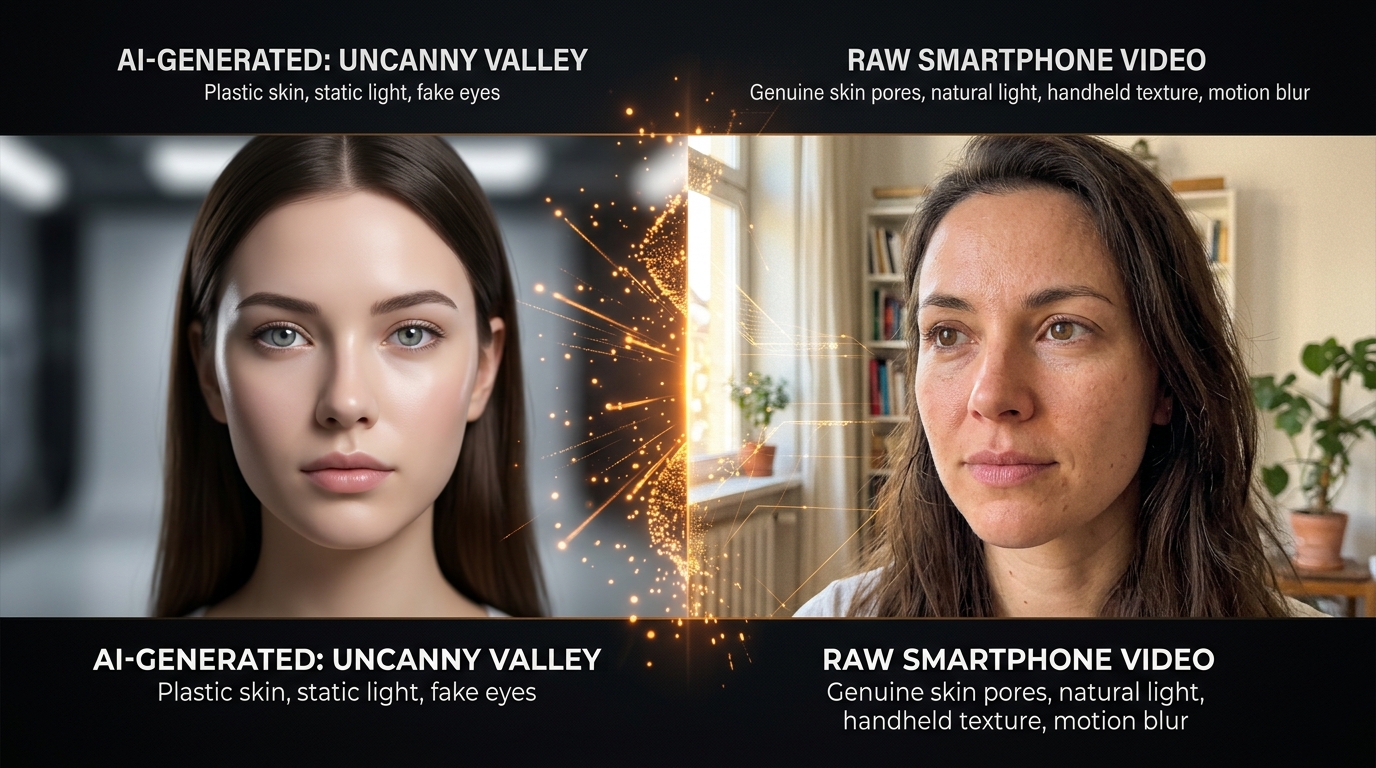
On social feeds in 2026, glossy perfection is an immediate red flag for fake sponsored content. The human brain has spent fifteen years sub-consciously registering the exact optical fingerprint of mobile camera sensors:
❌ Standard AI "Cinema" Output
- • Simulated 85mm portrait telephoto lenses with extreme, artificial background blur.
- • Wax-like, airbrushed skin with zero biological pores, blemishes, or micro-shadows.
- • Rigid, robotic camera motion mimicking a 100-pound motorized studio crane.
- • Over-graded, hyper-saturated color palettes resembling high-end Hollywood films.
✅ Real Smartphone Optical Reality
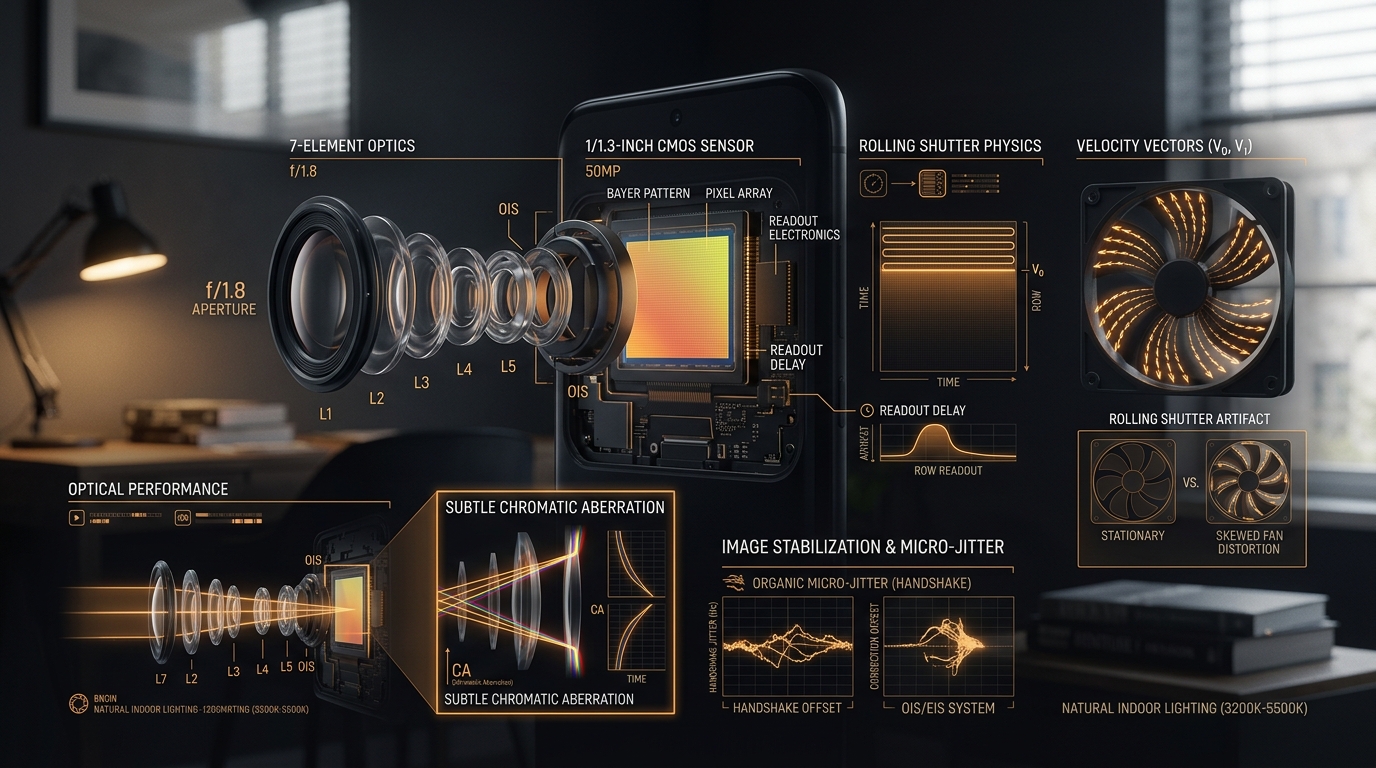
- • Small 1/1.3" CMOS sensor with wide 24mm field of view and deep depth of field.
- • Natural skin textures: fine lines, micro-pores, and authentic ambient light bounce.
- • Subtle handheld micro-tremors, organic refocusing, and slight rolling shutter cues.
- • Mixed everyday lighting: 5600K daylight through a window mixed with 2700K warm home lamps.
Technical Specs: Real Smartphone Hardware vs. Default AI Engines
To force neural video diffusion models to deliver believable mobile phone aesthetics, you must prompt using the exact physical principles governing smartphone optics:
| Physical Metric | Default AI Engines | Real Phone (UGC Target) | Recommended Prompt Directive |
|---|---|---|---|
| Focal Length | 50mm - 85mm (telephoto) | 24mm - 26mm (wide angle) | "shot on 24mm smartphone camera lens" |
| Depth of Field | f/1.2 (unrealistic background blur) | f/1.8 to f/2.2 with readable room environment | "deep depth of field, sharp background details" |
| Camera Motion | Smooth cinema rail or heavy gimbal | Organic handheld micro-movements (POV) | "handheld selfie camera micro-jitters, natural hand movements" |
| Facial Rendering | Over-smooth porcelain skin, robotic glare | Real skin pores, subtle flaws, natural reflections | "visible skin pores, subtle facial asymmetries, natural room daylight" |
| Sensor Compression | 16-bit noise-free clinical gradient | Subtle ISO noise and realistic social compression | "authentic phone footage grain, unpolished raw recording" |
The 3-Step DXBuilder Architecture: From Zero to Viral Phone Ad
At DXBuilder, we engineered a deterministic pipeline that systematically eliminates artificial video artifacts. Rather than relying on a blind, monolithic text-to-video prompt, we decouple image physics from kinetic motion:
Step 1: The Photographic Seed Frame
Never start from raw text prompts inside a video model when hunting for smartphone realism. Always generate a single hyper-calibrated still image first (using DXBuilder character sheets or Nano Banana 2). This seed frame anchors actor identity, clothing folds, environmental bounce light, and optical lens geometry.
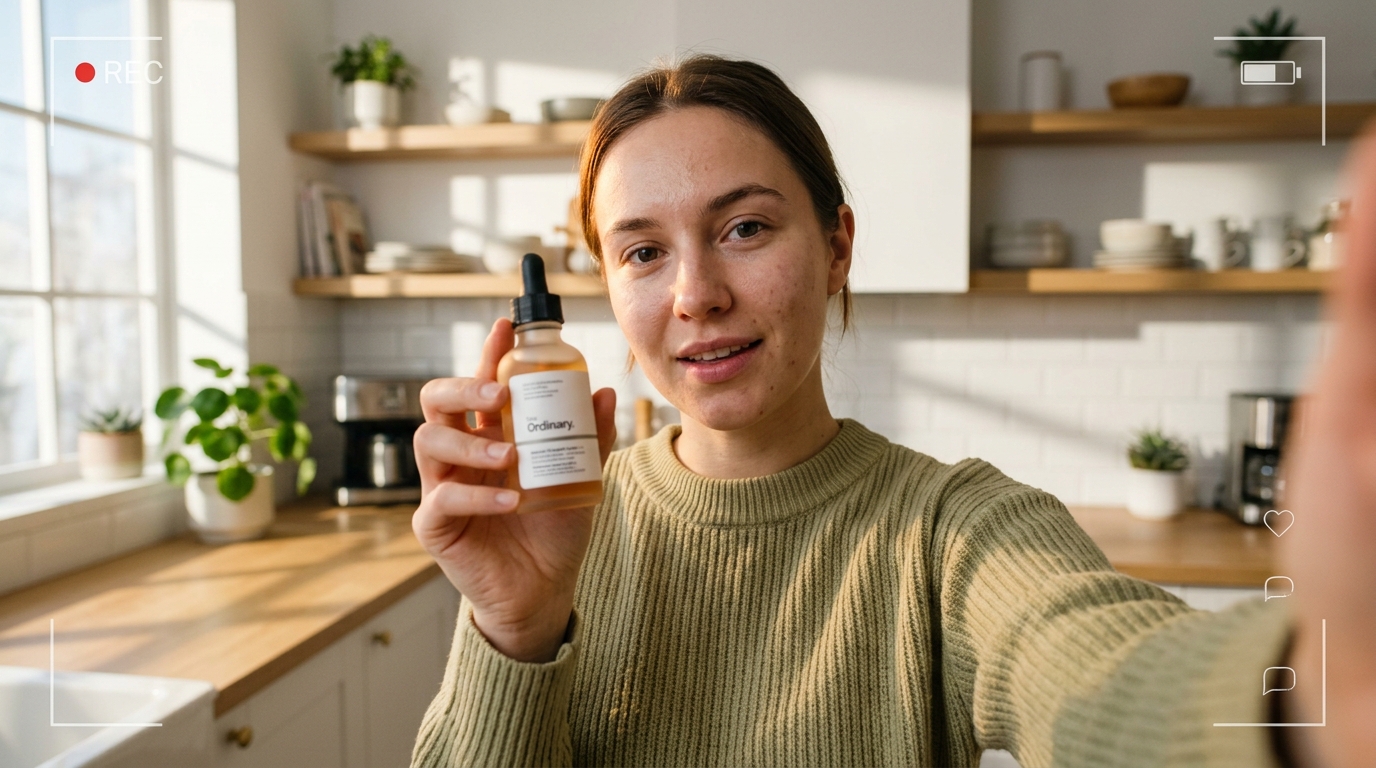
"Raw unedited smartphone photo taken with an iPhone 16 Pro 24mm main lens, front-facing camera angle. A 27-year-old woman smiling naturally while holding a minimalist skincare tube in her modern apartment kitchen. Natural daylight coming from a side window, soft natural room bounce light, realistic human skin pores, subtle flyaway hairs, no makeup airbrushing, casual t-shirt, 9:16 vertical ratio, authentic social media UGC look."
Step 2: Direct Image-to-Video Animation with Handheld Dynamics
Pass the photographic seed frame into our temporal Image-to-Video engine (Seedance 2.0 IR2V). Here is the golden rule: in the motion prompt, never describe the person or clothing again. If you re-state their hair color or shirt style, the diffusion model will attempt to re-render them from scratch, causing catastrophic face morphing. Describe kinetic action exclusively:
"The woman talks enthusiastically to the camera, gesturing naturally with her right hand while showing the cosmetic tube. Subtle natural eye blinks, organic head tilts, authentic handheld phone camera micro-jitters, natural breathing. The camera stays in authentic selfie POV framing."
Step 3: Conversational Voiceover & 30-Second Retention Pacing
To complete the illusion of authenticity, your audio must sound like an authentic individual talking into their phone in a living room—not a radio announcer in an acoustic foam booth. We leverage neural conversational TTS engines with natural pauses, subtle breaths, and authentic conversational cadence timed to 5–8 second scene blocks.
Model Benchmark: Which AI Engine Excels at Phone Footage in 2026?
Not all video diffusion architectures handle casual handheld aesthetics equally well. We benchmarked the leading engines across skin fidelity, identity consistency, and mobile authenticity:
| Video Model | Skin Realism | Identity Consistency | Smartphone Feel | Avg Cost / 5s Clip |
|---|---|---|---|---|
| Seedance 2.0 IR2V (DXBuilder) | 9.6 / 10 (Best in class) | 9.8 / 10 (Zero drift) | 9.5 / 10 (Native) | $0.13 - $0.20 |
| Wan 3.0 / 2.7 (Direct) | 8.9 / 10 (Very High) | 8.7 / 10 (Stable) | 9.1 / 10 (Natural) | $0.11 - $0.18 |
| Kling 1.6 / Omni | 8.4 / 10 (Good) | 8.2 / 10 (Minor drift) | 8.0 / 10 (Cinematic bias) | $0.28 - $0.45 |
| Grok Imagine Video 1.5 | 8.8 / 10 (Expressive) | 7.9 / 10 (Needs care) | 8.9 / 10 (Great native audio) | $0.16 - $0.24 |
3 Production-Ready Prompt Formulas for Maximum Social Conversion
Jumpstart your ad creation with these high-converting prompt frameworks refined across hundreds of campaigns:
Seed Frame: "Raw smartphone selfie camera snapshot, 25-year-old girl sitting on her living room couch with morning sunlight hitting her face through glass. Holding a frosted dropper bottle close to camera. Visible real skin pores, authentic subtle freckles, casual messy bun hairstyle, cozy oversized sweater. No CGI smoothness, real iPhone camera texture."
Motion (IR2V): "She talks casually to the camera, smiling warmly, holding up the dropper bottle to show the label, then applying a gentle drop to the back of her hand. Organic hand tremors, natural eye contact with camera, authentic breathing movements."
Seed Frame: "Authentic handheld phone video still, 34-year-old tech entrepreneur walking down a bustling city sidewalk, shot from a natural arm-length selfie angle. Natural overcast daylight, realistic city buildings softly out of focus in the background, casual navy hoodie, genuine facial expression, real skin imperfections."
Motion (IR2V): "He walks while talking energetically directly into the phone camera, dynamic handheld walking bob and subtle camera sway, natural facial expressions and authentic mouth articulation. Authentic vlog street aesthetic."
Seed Frame: "First-person POV smartphone photo looking down at a wooden desk under a warm desk lamp. Two human hands carefully opening a sleek minimalist matte black gadget box. Real finger details, authentic desk dust particles, realistic indoor warm ambient lighting, 24mm wide angle perspective."
Motion (IR2V): "Hands lift the lid of the box smoothly to reveal the device inside, one hand picks up the gadget and tilts it slightly to catch the warm lamp reflections. Realistic handheld camera adjustments, organic micro-movements."
Frequently Asked Questions (People Also Ask)
How do I prevent the actor's face from morphing or changing between cuts? ▼
The industry standard method is locking character sheets (@Hero) prior to generation inside DXBuilder. When passing the exact same seed reference image across all subsequent Image-to-Video calls using Seedance 2.0 IR2V, facial bone structure, eye shape, and identity remain 100% stable across all cutaways and scene transitions.
Will TikTok and Meta algorithms penalize AI-generated UGC videos? ▼
Social media recommendation engines do not penalize AI tools per se; they penalize poor viewer retention. When videos look unnervingly plastic or synthetic, viewers scroll away within 1 second, crashing organic reach and spiking advertising CPMs. By adhering to mobile optical physics and realistic sensor textures, retention rates match or exceed those of human creators.
What is the actual cost of producing a full 30-second AI UGC ad? ▼
Traditional UGC creators charge anywhere from $150 to $500 per video, requiring 1 to 2 weeks for delivery. Generating a 30-second commercial consisting of 5 high-converting cuts on DXBuilder costs between $1.50 and $3.20 in total compute, completed and ready for ad campaigns in under 20 minutes.
Should I render in 16:9 widescreen or directly in vertical 9:16? ▼
For TikTok, Instagram Reels, and YouTube Shorts, you should always render directly in 9:16 vertical. Leading 2026 diffusion architectures are trained natively on vertical smartphone frames, ensuring natural selfie angles, accurate arm reach, and organic composition without awkward post-crop distortion.
Start Producing Believable Phone Footage in Minutes
Join over 1,500 brands and solo creators who have bypassed plastic AI renders to generate high-converting, realistic mobile UGC commercials directly in their browser.
Filipe Heitor
Founder & AI ArchitectProduct engineer and founder of DXBuilder. Specialist in multimodal video diffusion orchestration, digital twin consistency, and frictionless automated content pipelines for global creators.