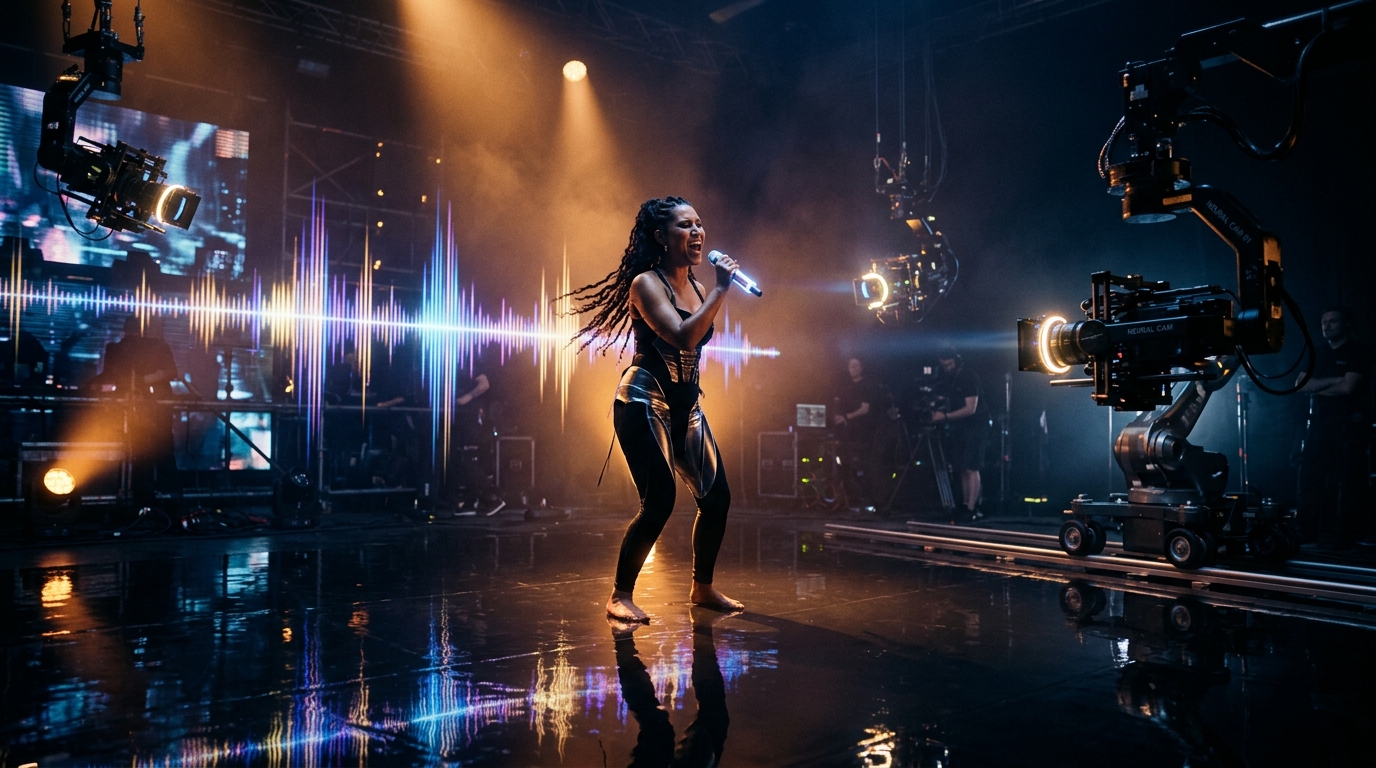
Until very recently, producing a professional 3-minute music video required between $10,000 and $30,000, lighting trucks, heavy camera cranes, and exhausting weeks of shooting and post-production. In September 2026, the convergence of multi-reference video diffusion models (such as ByteDance Seedance 2.0 IR2V, Alibaba Wan 3.0, and MiniMax H3) with music engines like Suno 5.5 has completely shattered this financial gatekeeper. Today, directors, indie record labels, and self-releasing artists are producing complete cinematic music videos with 20 to 30 sequential scenes, photorealistic concert lighting, unbreakable character consistency, and beat-synced rhythm cuts — with zero physical cameras and under 5% of traditional production costs.
Technical Definition: Generative AI Music Video Production
Generative AI Music Video Production is the audiovisual discipline of utilizing spatio-temporal diffusion neural networks and multimodal conditioning to synchronize the rhythmic cadence of an audio track (drum transients, basslines, and lyrical phrases) with photorealistic video sequences. By employing persistent identity tokens and photometric environment plates, directors preserve facial likeness, wardrobe, and atmospheric color grading across multiple camera framings (establishing wides, medium performance tracks, and macro inserts) without relying on physical film stages.
1. The Broken Economics of Music Videos: Why Visuals Used to Bankrupt Indie Artists
If you are a musician, indie producer, or label manager, you know this harsh reality all too well: you spend months perfecting a song. The mix sounds pristine. But when it comes time to launch on YouTube, Spotify Canvas, and TikTok, you hit an immovable financial wall:
- Exorbitant Studio Rental: Renting a soundstage with proper lighting trusses for a 2-day shoot runs $5,000 to $10,000 before factoring in insurance, gear transit, and crew catering.
- Bloated Production Crews: A traditional set requires a minimum of 15 to 25 technicians (cinematographer, gaffers, camera ops, sound engineers, continuity supervisors).
- Zero Margin for Weather or Gear Failure: If rain ruins an exterior location or a specialized lens arrives damaged, the day is wasted and budgets spiral out of control.
- Agonizing Post-Production: Manually conforming dozens of takes to timecode markers in DaVinci Resolve or Premiere Pro takes between three and five weeks.
The inevitable result? Over 90% of promising artists had to settle for static album artwork videos or cheap lyric animations that rarely engaged audiences. In 2026, that barrier has vanished.
2. The Four Pillars of AI Music Video Production in 2026
A compelling music video is not a random slideshow of disconnected visuals. Great directing requires narrative momentum, dynamic tension, camera variety, and unwavering singer identity. In our production workflow at DXBuilder, we structure every music video around four foundational pillars:
Rhythmic Stem Mapping & Cadence Analysis
Audio tracks are decomposed into fundamental stems: kick/snare transients, basslines, melodic synths, and vocal lead. Scene cutaways and camera acceleration vectors are mathematically locked to beat markers and harmonic drop transitions.
Visual Anchors & Style Masterplates
Before generating video motion, we create 16:9 4K environment masterplates using NanoBanana 2 in the DXBuilder Image Studio. This anchors the lighting color temperature, architectural style, and wardrobe palette.
Multi-Reference Conditioning (IR2V)
Leveraging Seedance 2.0 IR2V and Wan 3.0, we pass both the singer's anchor portrait and the environment plate simultaneously. The diffusion engine locks facial bone structure while generating expressive vocal performance.
Cinematographic Optical Pacing
We alternate intentionally between expansive wide establishing shots, dynamic medium tracking orbits, and macro lens close-ups (guitar fretwork, analog synthesizer dials, and vintage stage microphones) to keep the viewer captivated across all 3 minutes.
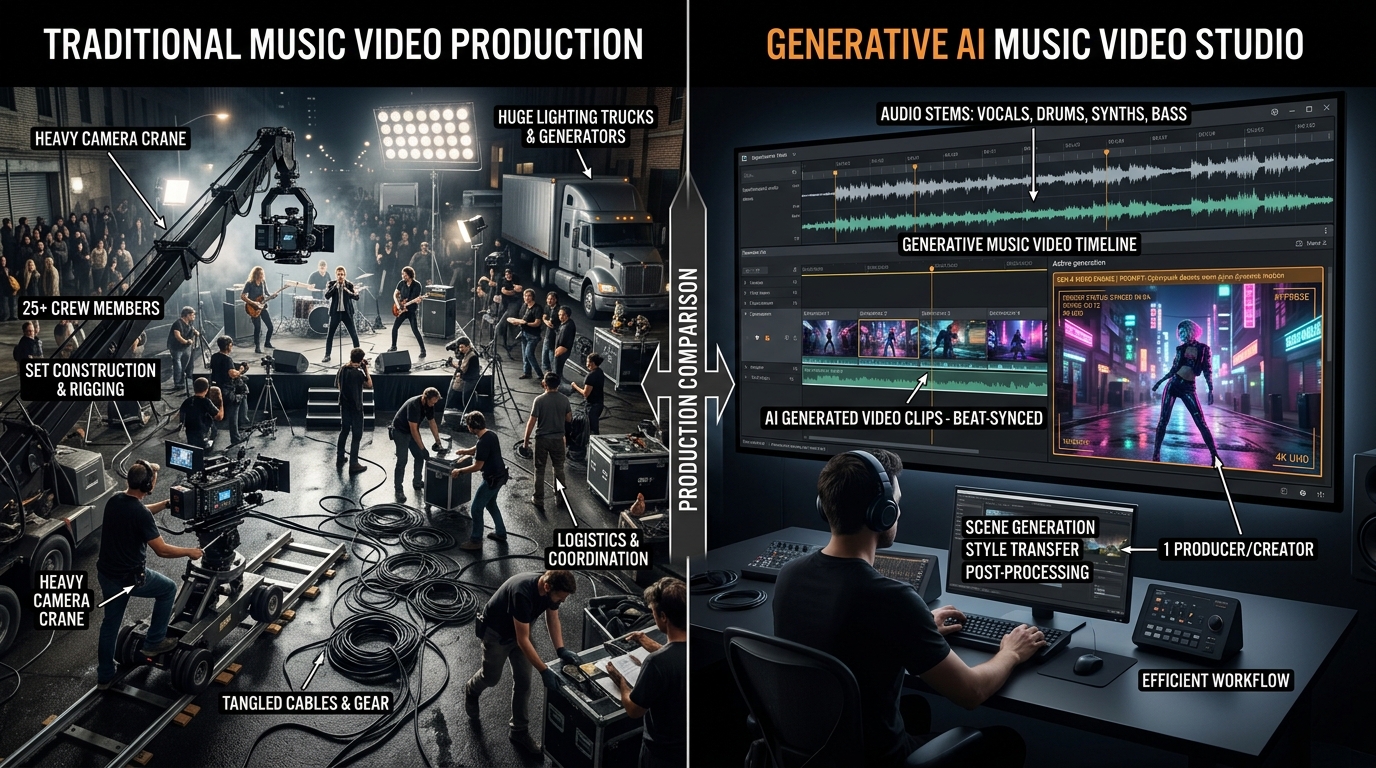
3. Comparative Breakdown: Traditional Set vs. 3D CGI vs. Generative Multimodal Pipeline
Here are the real-world production metrics compiled directly from our commercial studio operations:
| Production Metric | Traditional Indie Set | 3D CGI / Unreal Engine | AI Pipeline (DXBuilder) |
|---|---|---|---|
| Average Cost per 3-Min Music Video | $10,000 – $30,000 | $15,000 – $45,000 | $50 – $150 (GPU render credits) |
| Turnaround Time to Final 4K Master | 3 to 6 weeks | 4 to 8 weeks | 3 to 6 hours (same-day delivery) |
| Crew Footprint Required | 15 to 30 technicians | 4 to 8 3D artists | 1 solo creator / director |
| Location & Aesthetic Versatility | 1 to 2 physical rented stages | Constrained by available 3D assets | Unlimited (cyberpunk metropolises, neon deserts, stadiums) |
| Cost of Re-shooting a Scene After Cut | Prohibitive (requires another full shoot day) | High (days of re-lighting and rendering) | Instantaneous (regenerate single take in seconds) |
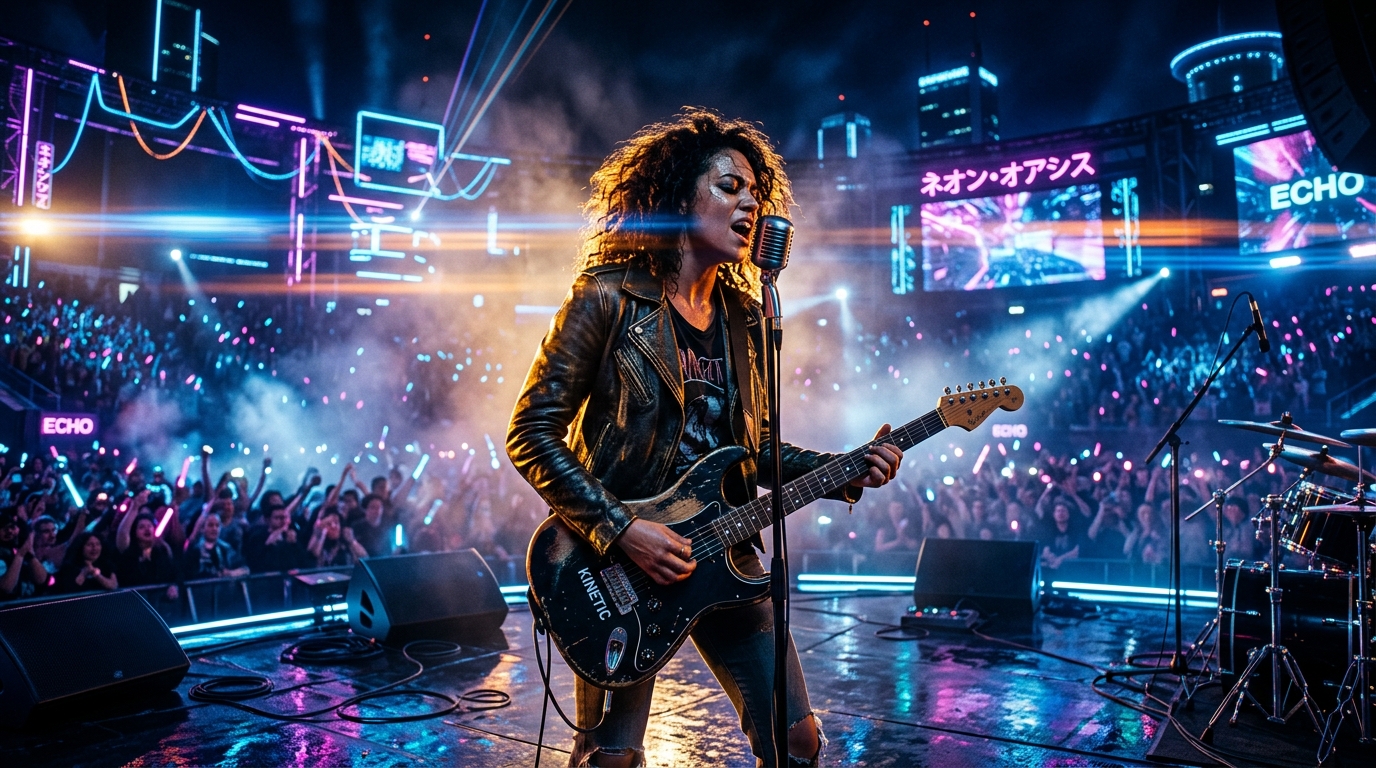
4. Three Copy-Paste Production Prompt Formulas for Your Next Video
To prevent GPU credit waste and eliminate unwanted model hallucinations, use these field-tested formulas directly within our engine:
Cinematic concert stage background plate for high-energy music video, dark brutalist amphitheater with polished wet black concrete floor reflecting overhead neon lighting trusses, volumetric amber (#FF9B3E) and deep cyan haze beams slicing through atmospheric smoke, empty stage with vintage tube amplifiers and floating mic stand, anamorphic 35mm lens bokeh, Panavision aesthetic, photorealistic 8k architectural render, no people, master framing --ar 16:9
Filipe's Pro Tip: Always generate the plate clean without actors (no people) to establish an unwavering lighting and perspective baseline.
Cinematic music video performance shot, musical artist singing with raw authentic passion into a vintage stage microphone, intense eye contact with lens, subtle rhythmic body movement matching musical downbeat, dramatic amber rim light tracing jawline and leather jacket silhouette, wet stage floor reflections, slow smooth camera push in with slight Dutch angle rotation, natural motion blur, 24fps cinematic shutter, 4k ultra-high definition.
Filipe's Pro Tip: Pairing slow smooth camera push in with slight Dutch angle rotation delivers the hallmark energy of modern alternative and hip-hop cinema.
Cinematic abstract music visualizer B-roll, extreme close-up macro lens shot of vintage vacuum tube glowing intensely with pulsating warm amber filaments pulsing to the audio rhythm, glass reflection anomalies, rising wisps of delicate stage incense smoke catching prismatic neon blue flares, high-speed 60fps slow-motion capture, shallow depth of field, high contrast chiaroscuro lighting, luxury music video aesthetic.
5. End-to-End Workflow on DXBuilder: From Audio File to 4K Master
When building DXBuilder, our core mission was to eliminate all technical friction between a musical idea and a breathtaking visual release. Here is the exact blueprint to execute your next project:
- Audio Composition & Upload: Generate original tracks using Suno 5.5 inside our Music Studio or import your finished studio master.
- Actor Likeness Locking in Characters: Navigate to DXBuilder Characters to configure a persistent identity card for your vocalist, preventing facial morphing across scenes.
- Environment Plate Generation in Image Studio: Generate 3 to 5 master scenes using NanoBanana 2 in the Image Studio.
- Multi-Shot Video Directing: Assemble sequence takes in the Video Studio or deploy our curated 1-click Presets powered by Seedance 2.0 and Wan 3.0.
- Predictable, Fair Pricing: Choose a monthly plan or top up with on-demand credit bundles on our Pricing Page without lock-in contracts.
6. Frequently Asked Questions (FAQ)
How do I align drum transients and bass drops with video cut transitions?
The golden rule is mathematical bar pacing: at 120 BPM, a standard 4-beat bar lasts exactly 2.0 seconds. Timing your video clips in 2s, 4s, or 6s increments with fast camera moves at the head of the clip ensures every transition hits cleanly on downbeats.
Do YouTube, VEVO, and Spotify Canvas allow AI-generated music videos?
Yes, fully monetizable across all platforms provided your audio rights are verified. YouTube simply requires toggling the "altered/synthetic content" disclosure badge, which carries zero algorithmic or organic reach penalties.
How do you prevent identity drift across 20 different music scenes?
Through DXBuilder's latent character anchoring: you configure the subject once in /characters. When referencing that anchor in Seedance 2.0 or Wan 3.0, the model freezes facial bone structure while allowing lighting and emotional performance to adapt dynamically.
What does a full 3-minute music video actually cost in GPU credits?
A dynamic music video typically uses 20 to 25 sequence takes (each 5 to 10 seconds). In DXBuilder, this equates to roughly $50 to $100 in high-end GPU compute, compared to $10,000+ for a comparable physical shoot.
Filipe Heitor
Founder & Lead Architect • DXBuilder
For years, we watched incredible musical acts get ignored simply because they couldn't afford a $20,000 video shoot. We built the DXBuilder ecosystem to democratize top-tier cinematic storytelling. If you have great music, camera budgets will never hold you back again.