Decision Matrix: Who Each Engine Is For (And Who Should Skip)
The two most common questions asked by creators, marketers, and filmmakers on Reddit and Google are straightforward: "Which AI video generator should I choose?" and "What is the actual difference between them?" Here is the unfiltered engineering breakdown:
| Ideal for (Best for) | Skip or wait if |
|---|---|
| Seedance 2.5 IR2V: E-commerce brands, paid ad agencies, and directors needing unbroken 30-second shots where product labels, garments, and actor faces stay locked without melting. | You only want to type three vague words without supplying an anchor reference image — Seedance shines brightest when anchored by visual references. |
| Kling 4.0 Flash: Cinematographers demanding native 4K HDR (10-bit) and choreographed camera trajectories across up to 10 temporal keyframes from second 0 to 30. | You need rapid sub-10-second exploratory drafts or are running high-volume, ultra-low-budget social tests. |
| MiniMax H3 (Ref2VA): UGC creators, faceless channels, digital presenters, and music video directors who need a human character to speak or sing with frame-accurate lip-sync and natural eye emotion in one pass. | You expect to run the full unquantized checkpoint locally on a consumer 16 GB or 24 GB GPU without severe quality loss. |
| Alibaba Wan 3.0 / 2.6: Multi-scene filmmakers inside Story Lab, complex fluid dynamics (rain, ocean, smoke, crowds), and 30-second narrative takes with top credit efficiency. | Your shot requires razor-sharp micro-typography on a cosmetic bottle without first generating an anchor frame in Nano Banana 2.1. |
Proven Strengths vs. Real Bottlenecks (October 2026 Generation)
| Proven Advantages (Pros) | Real Limitations & Bottlenecks (Cons) |
|---|---|
| ✓ Death of the 5-second ceiling: Seedance 2.5, Kling 4.0, and Wan 3.0 generate up to 30 continuous seconds while preserving 3D scene geometry. | ✗ Massive local VRAM barrier: Frontier audio-visual checkpoints exceed 130 GiB in BF16, making full-precision local execution impossible on standard desktop PCs. |
| ✓ Single-pass Audio & Lip-Sync: MiniMax H3 and Seedance synthesize voice, Foley SFX, and phoneme-to-viseme mouth motion together, ending blurry third-party dubbing. | ✗ Raw Text-to-Video still hallucinates brand logos: Without an anchor image, any video model will still improvise packaging text. |
| ✓ Unified Multimodal Pipeline: In DXBuilder, you craft a 10-reference 4K still in Nano Banana 2.1, score a track in Suno, and animate 30s of video in one workspace. | ✗ Compute time at 30s 4K: While 480p drafts finish rapidly, full 30-second multi-reference renders require 45 seconds to 4 minutes of GPU cluster compute. |
What Is the Actual Difference Between AI Video Generators in 2026?
When OpenAI shut down the Sora consumer app and retired the Sora API in late September 2026 due to unsustainable per-second inference costs, many newcomers wondered where the industry was heading. Beneath the hood, all leading 2026 engines use spatio-temporal Diffusion Transformers (DiT), but each lab optimized its attention mechanism for a distinct visual engineering challenge:
Product & Biometric Identity Lock
The defining edge of Seedance 2.5 is its Identity-Preserving Reference-to-Video (IR2V) architecture. Whereas older engines treat a starting image as a loose hint and warp the actor's face as soon as they turn 90 degrees, Seedance locks biometric facial vectors and rigid product geometry (watches, bottles, cars) across all 30 seconds.
10-Keyframe Control & 10-bit HDR
Kling 4.0 stands apart through optical trajectory control. It is the premier choice when a director needs to lock the opening frame, intermediate milestones (up to 10 keyframe anchors), and final pose, outputting 10-bit color depth ready for DaVinci Resolve color grading.
Human Performance & Joint Audio-Video
Instead of the broken legacy pipeline (generate silent video $ ightarrow$ generate TTS voice $ ightarrow$ paste blurry mouth with Wav2Lip), MiniMax H3 performs joint audio-visual denoising. When an actor speaks or sings, cheek muscles, neck tension, breathing, and eye micro-movements match the vocal inflection natively.
World Dynamics & Narrative Continuity
Wan 3.0 excels at fluid dynamics, rain refraction, volumetric smoke, and wide environmental motion up to 30 seconds at the best credit-to-duration ratio. Meanwhile, Veo 3.1 focuses on rapid short clips with conversational audio.
Technical Specifications at a Glance (October 2026)
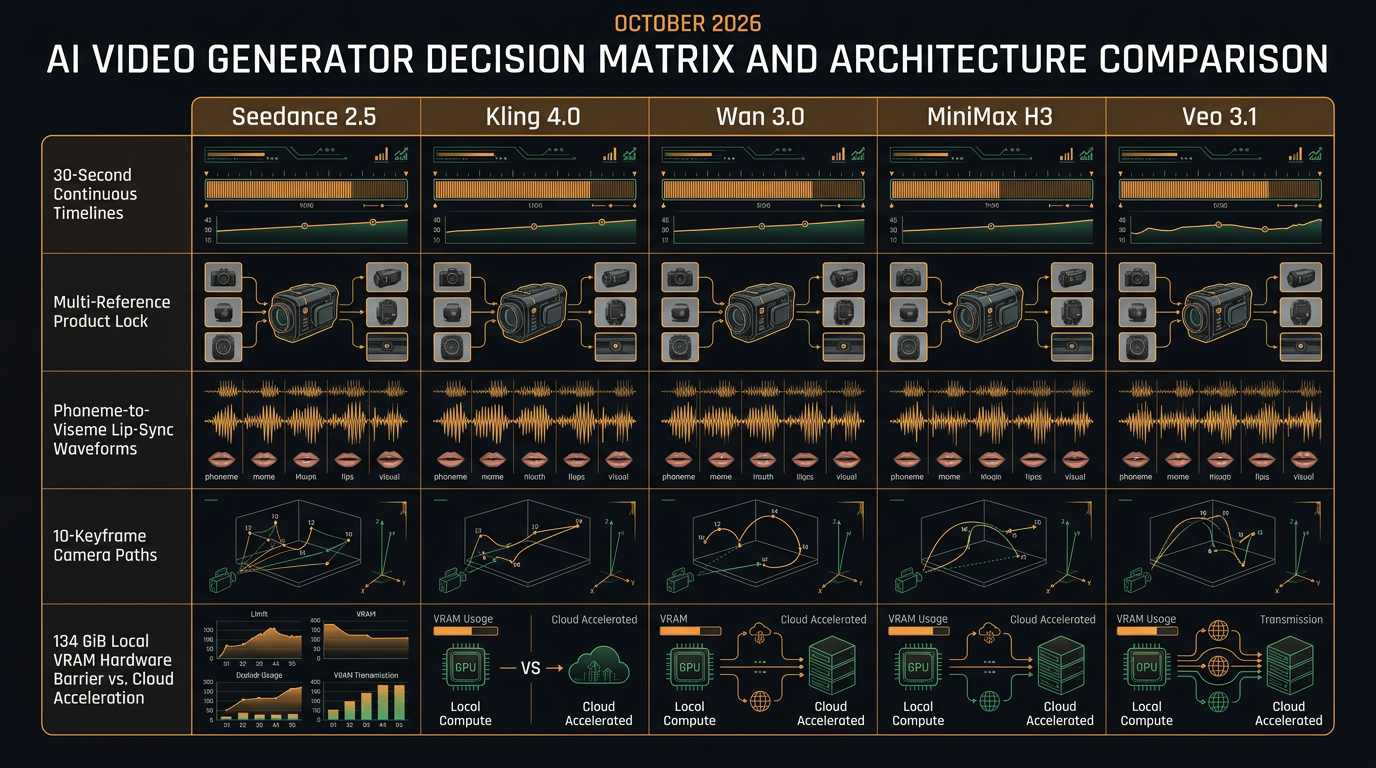
For teams evaluating hard engineering metrics before committing production budget, here is the side-by-side specification table:
| Engine / Model | Max Duration | Max Resolution | Audio & Lip-Sync | Reference Control | Primary Production Use |
|---|---|---|---|---|---|
| Seedance 2.5 IR2V | 30s unbroken | 1080p / 4K UHD | Native (SFX + Voice) | Multi-Ref (Actor + Product + Light) | Product Ads, E-commerce, Fashion |
| Kling 4.0 Flash | 30s unbroken | 4K HDR (10-bit) | Stereo + Lip-Sync | Up to 10 Temporal Keyframes | Cinema, Action, Camera Choreography |
| MiniMax H3 (Ref2VA) | 15s - 20s | 768p (Local) / 2K (Cloud) | 32 kHz + 99% Viseme Sync | Portrait + Vocal Stem + Prompt | Talking Actors, UGC, Music Videos |
| Alibaba Wan 3.0 | 30s unbroken | 720p / 1080p / 2.5K | Ambient + Dialogue | Anchor Frame + Scene Handoff | Story Lab Series, Nature, VFX |
| Google Veo 3.1 | 8s - 15s | 1080p / 4K | Native Integrated | Up to 3 Guide Images | Fast B-Roll, Social Shorts |
Hardware Reality Check: Why You Cannot Run Full Frontier Video Models on a Normal Desktop (134 GiB Breakdown)
A frequent question across r/StableDiffusion and r/generativeAI is: "Can I just download a top-tier 2026 video model and run it for free on my gaming PC?" Looking at the physical disk and VRAM footprint of a full-precision (BF16/FP32) joint audio-video pipeline explains why local execution hits an immediate wall:
| Neural Pipeline Module | Weight Size (GiB) | Role in Spatio-Temporal Inference |
|---|---|---|
| Multimodal Context Encoder | 62.13 GiB | Deep semantic parsing of long prompts, reference images, and audio stems |
| Core Audio-Visual DiT Transformer | 61.73 GiB | Joint spatio-temporal denoising of video frames and synchronized sound waves |
| Visual VAE (Variational Autoencoder) | 9.70 GiB | 16x spatial compression and flicker-free temporal frame decoding |
| Stereo Audio VAE | 0.56 GiB | 32 kHz / 48 kHz stereo waveform synthesis locked to lip motion |
| Total Unquantized Memory Footprint | 134.12 GiB | Requires multi-GPU server node (e.g., 2x H100 or 4x RTX 5090 with heavy offloading) |
Even if you spend $2,600+ on an NVIDIA RTX 5090 (32 GB VRAM), you are forced to use aggressively quantized weights (Q4 GGUF) and slow system RAM offloading — waiting 12 to 18 minutes for a single 5-second 720p clip. Inside DXBuilder, all inference runs on dedicated cloud clusters straight from your browser, even on a lightweight laptop or phone.
Render latencies, identity preservation benchmarks, and resolution comparisons in this guide are based on hands-on production runs inside DXBuilder's studio infrastructure in October 2026 (across integrated Seedance IR2V, Wan, MiniMax H3, Nano Banana 2.1, and Suno pipelines), cross-checked against official technical specifications published by ByteDance, Kuaishou, Alibaba Cloud, MiniMax, and Google DeepMind. Actual visual output depends on reference image quality and prompt structure.
Practical Playbook: Which Workflow Should You Use Today?
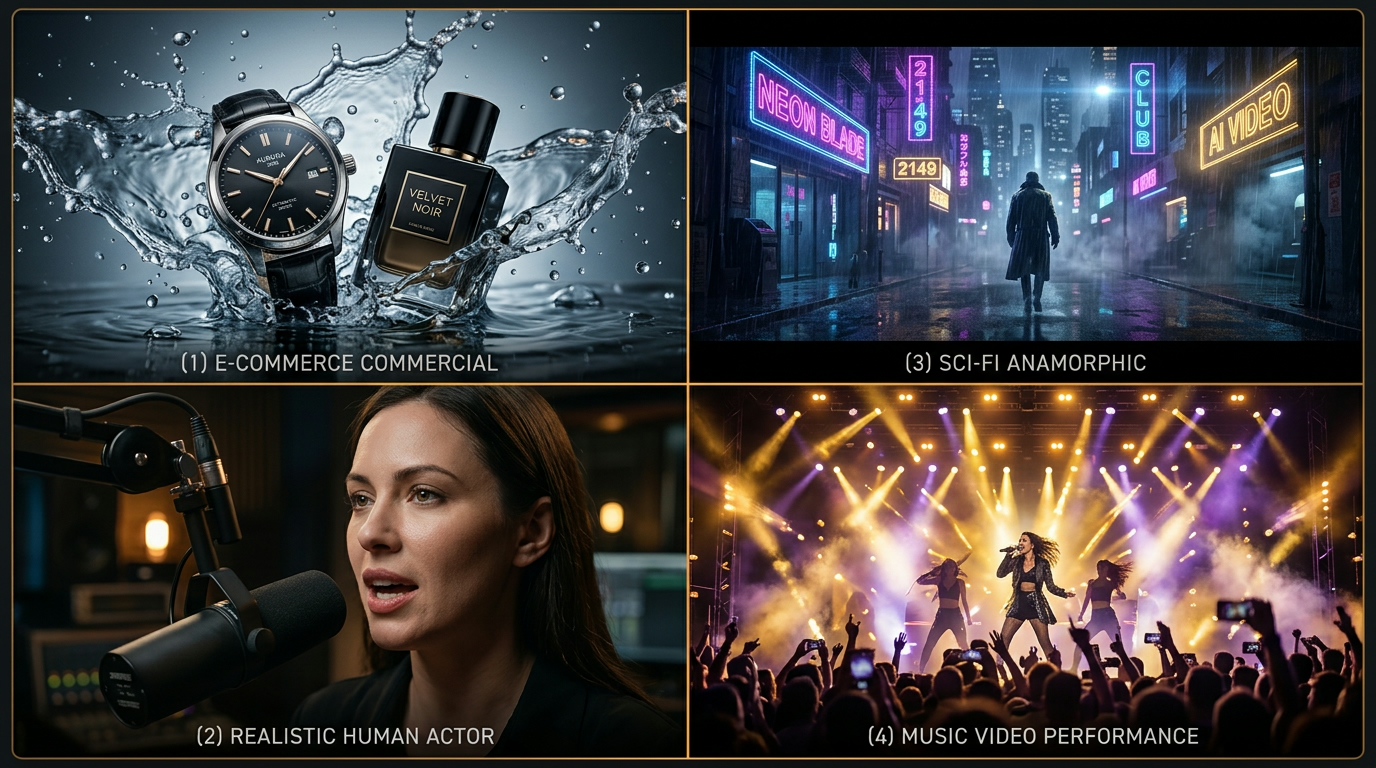
Instead of wasting budget testing isolated apps, follow this battle-tested routing workflow used daily by agencies and creators on DXBuilder:
1. For E-Commerce Ads, Cosmetics, Watches, or Fashion
The Winning Workflow: Start in DXBuilder's Image Studio (Nano Banana 2.1) by uploading your real product photo + model reference + lighting guide (supports up to 10 simultaneous references in native 4K). Then pass that pristine anchor frame directly into Seedance 2.5 for a 15-to-30-second commercial with zero logo distortion.
2. For Videos Without Filming or Acting (UGC, Presenters, Podcasts)
The Winning Workflow: Lock your recurring digital spokesperson in Characters (@Hero). Pair them with MiniMax H3 or Seedance and Audio Studio voices for lifelike spoken delivery, natural eye contact, and accurate lip-sync.
3. For Music Videos & Viral Social Reels
The Winning Workflow: Generate a full broadcast-grade song with vocals in DXBuilder's Music Studio (Suno), then launch the Music-to-Video timeline to choreograph visual cuts synced to the beat.
4. For Beginners Wanting 1-Click Cinematic Results
The Winning Workflow: If you are new to AI video and don't want to write complex camera lens prompts, open the 1-Click Presets catalog (available in 9:16 vertical for TikTok/Reels or 16:9 widescreen). Pick a template, upload your photo, and click Generate.
3 Battle-Tested Production Prompt Formulas
Copy and paste these exact prompt structures into the DXBuilder Video Studio:
[ANCHOR IMAGE: @Image1 luxury chronograph watch on wet black basalt]
Continuous 30-second single-take commercial shot: Camera begins in an extreme macro close-up of the sapphire crystal dial and sweeping second hand, slowly pulling back and orbiting 180 degrees around the watch as fine golden water droplets fall in slow motion across the brushed titanium strap. Warm amber rim lighting (#FF9B3E) contrasting with deep obsidian shadows. Zero geometry distortion on watch hands and typography.
[AUDIO: Crisp mechanical ticking, gentle water droplets splashing on stone, deep cinematic sub-bass swell — NO unwanted speech]
[CHARACTER LOCK: @Hero1 founder in a modern dark podcast studio with warm amber LED tube in background]
Medium close-up shot filmed on 50mm prime lens at f/1.8. The speaker looks directly into the camera lens with natural micro-expressions, subtle eyebrow movement, authentic skin pores, and natural breathing while delivering the dialogue clearly. Camera holds a steady handheld micro-sway for authentic documentary realism.
[AUDIO: Warm studio condenser microphone voice delivery with natural room acoustics]
Unbroken 30-second anamorphic tracking shot: Camera follows a lone cyber-detective walking through a rain-slicked Tokyo alleyway at night, neon reflections shimmering in puddles (#FF9B3E amber and cyan). At second 12, the camera smoothly cranes upward as a futuristic transport vessel passes overhead, sending wind ripples through the detective's trench coat and umbrella. Volumetric fog, optical lens flares, photorealistic rain physics.
[AUDIO: Heavy rain hitting umbrella and wet asphalt, distant neon transformer hum, deep atmospheric turbine roar overhead]
Frequently Asked Questions (People Also Ask / Google & Reddit)
What is the best AI video generator for beginners in 2026?
For beginners, the biggest trap is starting with node-based local setups (like ComfyUI) or raw text-only tools that require complex cinematography jargon. The best choice is a unified platform like DXBuilder, which combines 1-Click Presets with an integrated AI Director that automatically expands simple ideas into professional 30-second scenes across Seedance 2.5 and Wan 3.0.
What is the main difference between Seedance 2.5, Kling 4.0, and Wan 3.0?
While all three support continuous generation up to 30 seconds, their core strengths differ: Seedance 2.5 leads in strict product geometry and multi-reference facial identity lock; Kling 4.0 specializes in 4K HDR 10-bit output with up to 10 keyframe camera anchors; and Wan 3.0 delivers the most natural environmental fluid physics and best credit efficiency for multi-scene storytelling.
What happened to OpenAI Sora and what is the best replacement?
OpenAI closed the Sora consumer app and completed the shutdown of the Sora API in late September 2026 due to high per-second compute costs. Today, Seedance 2.5, Wan 3.0, and Kling 4.0 have surpassed legacy Sora in unbroken duration (30 seconds vs. short snippets), reference consistency, and synchronized audio.
Can I use AI to create realistic videos without acting or filming?
Yes. By locking a digital actor in DXBuilder's Characters module, generating 4K studio anchor stills in Nano Banana 2.1, and animating with native voice and lip-sync in the Video Studio, you can produce commercials, UGC ads, and narrative films with zero physical cameras or microphones.
Run Seedance 2.5, Wan 3.0, MiniMax H3, Nano Banana 2.1 & Suno Inside DXBuilder
Stop juggling five expensive subscriptions. Generate unbroken 30-second videos, 10-reference 4K imagery, and full vocal tracks directly in your browser.
About the Author: Filipe Heitor
Founder and AI Architect at DXBuilder. Filmmaker and engineer specializing in 30-second spatio-temporal video diffusion pipelines, multi-reference conditioning, and scalable commercial production.