Decision Matrix: Who Should Use Kling 4.0 (And Who Should Stick to Seedance 2.5 or Wan 3.0)
Every major model release arrives wrapped in marketing buzzwords about "breakthrough narrative realism." When we strip away the cherry-picked demos and examine real stress tests—dramatic dialogue, slow-motion martial arts, Pixar/Anime styling, and multi-reference short film cuts—here is where Kling 4.0 actually stands:
| Best for | Skip or switch engines if |
|---|---|
| Photorealistic Drama & Dialogue-Heavy Scenes: Medium and close-up dramatic shots where subtle throat muscle movement, clean voice cloning (>5s audio reference), and zero metallic audio wobble are paramount. | You want fast-paced martial arts or combat from a simple text prompt—without keyframes or video references, fighters slide across the floor ("ice-skating") and spatial positions teleport mid-cut. |
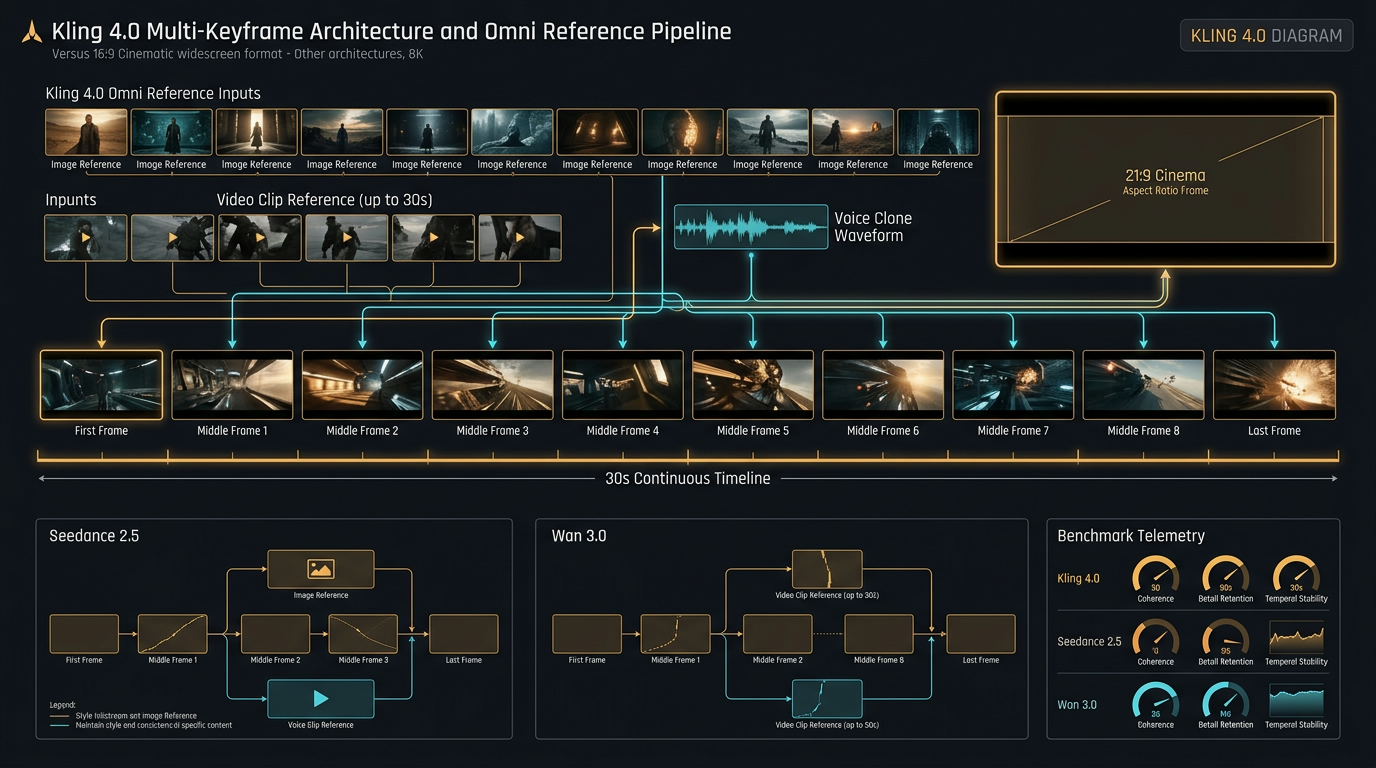
| 10-Keyframe Shot Choreography: Creators who pre-generate exact story beats in Nano Banana 2.1 (First Frame + up to 8 Middle Frames + Last Frame) to force specific slow-motion impacts and camera angles. | You need Multi-Keyframe camera control AND spoken dialogue/Elements in the same generation—Kling 4.0 disables Elements and speech whenever Multi-Keyframes are active. |
| 21:9 Cinema Aspect Ratio & Regional Accents: Filmmakers shooting widescreen 21:9 narratives requiring specific vocal dialects (American/British English, Portuguese, Spanish, Beijing/Taiwanese Mandarin). | You rely on low-cost 480p draft iterations to test blocking before final rendering, or need strict multi-character instruction following (where Seedance 2.5 remains clearly ahead). |
Verified Pros vs. Real-World Cons of Kling 4.0
| Verified Strengths (Pros) | Real Bottlenecks & Limitations (Cons) |
|---|---|
| ✓ Native 30-second duration: Joins Seedance 2.5 and Wan 3.0 in the 30-second tier, while also supporting up to 5 reference videos with a 30s combined duration. | ✗ 4K & 10-bit HDR missing at launch: Despite being listed on the spec sheet, 4K resolution and 10-bit HDR color depth are not yet active in the initial release. |
| ✓ Zero audio wobble on dialogue: Unlike Seedance 2.0/2.5, Wan 3.0, and Hailuo—which occasionally produce metallic warbling on long sentences—Kling 4.0 kept voice tracks distortion-free across every dialogue test. | ✗ Unassisted fight physics break apart: Fast combat causes limb distortion, sliding feet, missing impact sound effects, and sudden character teleportation at the end of clips. |
| ✓ Up to 10 Keyframes (First + 8 Middle + Last): Forces the diffusion engine to hit your exact storyboard frames without writing 2,000-word second-by-second JSON prompts. | ✗ No 480p budget draft mode: Starting at 720p means every prompt experiment consumes full resolution credits, unlike Wan 3.0 or Seedance Mini. |
| ✓ 8,000-token prompt capacity & strong V2V background lock: Video reference tracking keeps backgrounds remarkably stable even during acrobatic human motion. | ✗ Facial identity drift during rapid landings: In high-speed Video-to-Video flips, the subject's face distorted and lost its original Asian features upon landing. |
Technical Specifications at a Glance: Kling 4.0 vs. Seedance 2.5 vs. Wan 3.0
To see exactly how Kling 4.0 compares against the flagship engines available inside the DXBuilder Video Studio, here is the side-by-side engineering breakdown:
| Specification | Kling 4.0 (Oct 2026) | Seedance 2.5 IR2V | Alibaba Wan 3.0 |
|---|---|---|---|
| Max Native Duration | Up to 30 seconds | Up to 30 seconds | Up to 30 seconds |
| Active Resolutions | 720p, 1080p (4K/10-bit later; no 480p) | 480p, 720p, 1080p, 4K UHD | 480p, 720p, 1080p |
| Aspect Ratios | 21:9, 16:9, 1:1, 9:16 (no 3:4) | 16:9, 9:16, 1:1, 4:3, 3:4, 21:9 | 16:9, 9:16, 1:1, 4:3, 3:4 |
| Prompt Token Limit | 8,000 tokens / characters | Multi-shot structured prompt | Long-form scene director prompt |
| Omni Reference Capacity | Up to 15 total (10 imgs, 5 videos/30s, 7 Elements, voice >5s) | Up to 12 refs with strict IR2V lock | Images + video ref (up to 15s) + voice |
| Keyframe Control | Up to 10 Keyframes (no Elements/Audio) | First/Last Frame + Motion Ref + Audio | First/Last Frame + Story Lab Continuity |
| Dialogue & Audio Quality | 2-Ch Stereo, zero wobble + Voice Clone | Rich Foley + Speech (minor wobble risk) | Native V2A foley + multi-language speech |
Inside the 5 Real-World Stress Tests: Where Kling 4.0 Shines and Where It Breaks
Official launch trailers are always cherry-picked by studio engineers. To give filmmakers an honest assessment, let's examine how Kling 4.0 performed across five demanding production tests:
Anatomical Throat Movement & Zero Audio Wobble
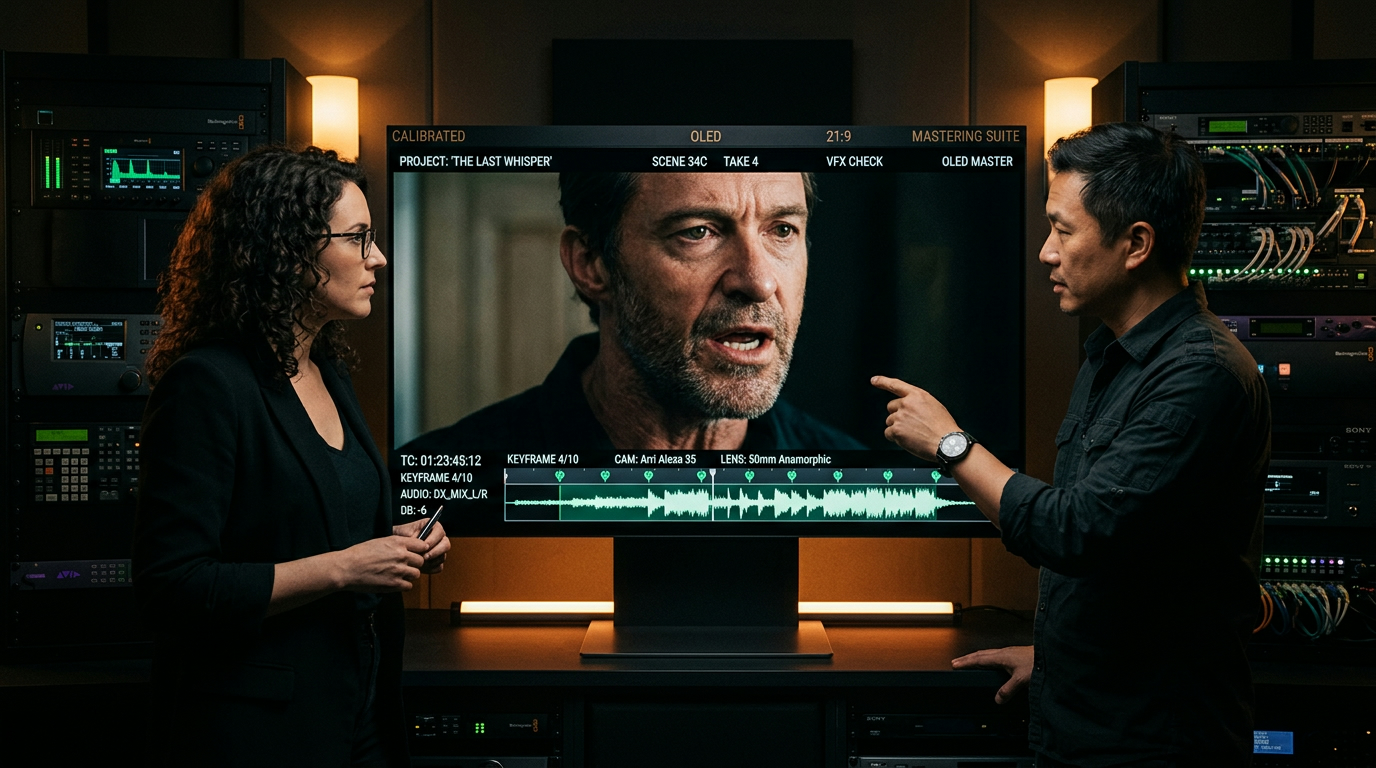
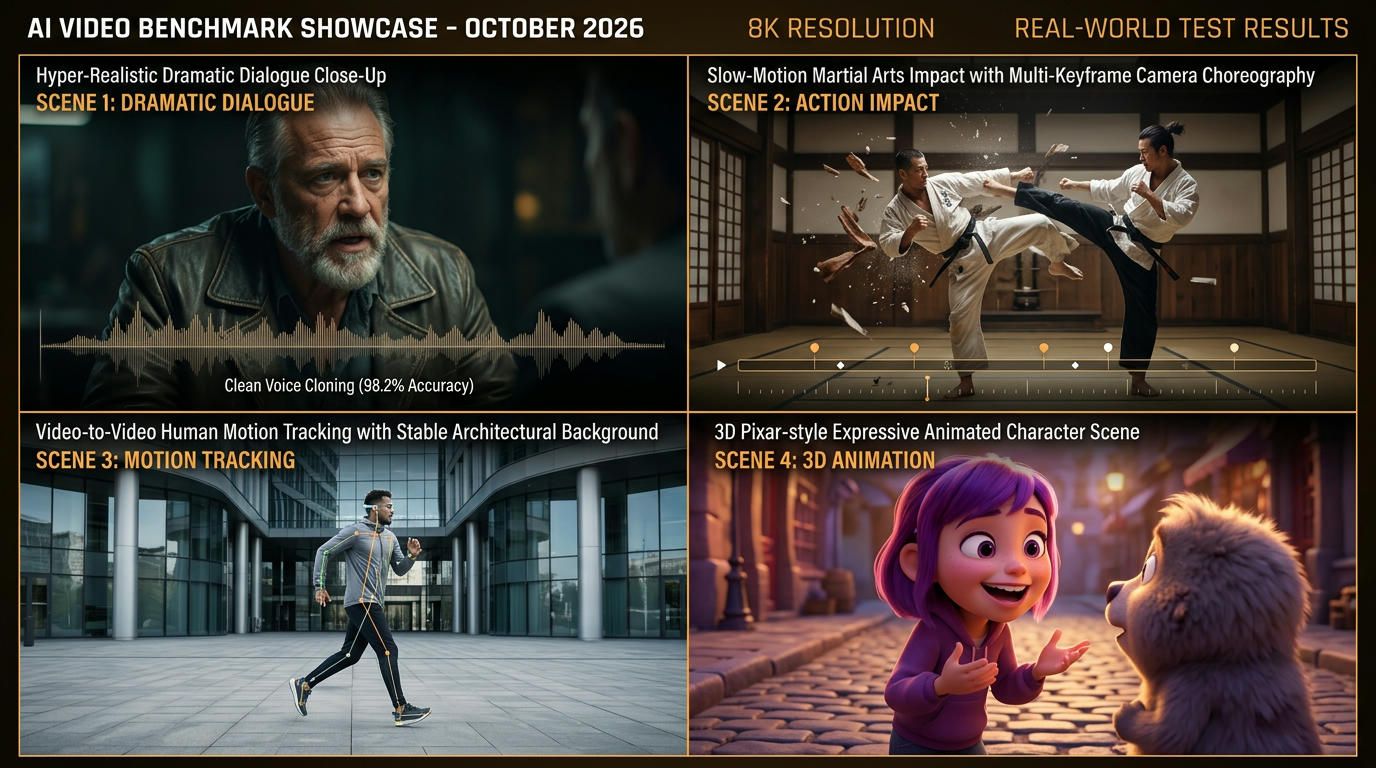
In both the two-person comedy exchange ("Tell me you brought the spare key... Inside the room we just locked?") and the dark fantasy monologue ("My lord, the gate is open..."), Kling 4.0 delivered standout photorealism. You can visibly see the actor's throat muscles flexing naturally as he speaks. When paired with an external voice actor reference (>5s audio clip), voice cloning was crisp and completely free of the metallic audio wobble that occasionally plagues other 30-second models.
The "Ice-Skating" Artifact & Spatial Teleportation
Without multi-keyframes or video references, fast combat is Kling 4.0's weakest point. In the live-action brawl, the anime Darth Maul duel, and the slow-motion "This is Sparta" kick test, rapid movements caused characters to slide backwards across the floor like ice skaters. Wall impacts lacked matching foley sound effects, and character positions suddenly teleported to the edge of a ledge between cuts.
Great Scenery, But Seedance 2.5 Wins on Instructions
When tested on a real short-film contest scene combining two character sheets and two environment plates, Kling 4.0 rendered realistic background textures and preserved signage text from the reference images. However, the cut timing felt mushy and instruction adherence fell short—running the exact same scene in Seedance 2.5 produced significantly tighter narrative blocking and cleaner sound design.
Deterministic Control Over Slow-Motion Impacts
Everything changed when switching to Multi-Keyframe mode (First Frame + up to 8 Middle Frames + Last Frame). Because Kling 4.0 is forced to route the latent trajectory through every middle frame (such as a slow-motion punch landing on frame #2), the fight sequence suddenly looked genuinely cinematic. Just remember the golden rule: Multi-Keyframe mode locks out Elements and dialogue, so voice and music must be added in post.
API Pricing Uncertainty, the 134 GiB VRAM Wall & Why Cloud Routing Wins
With third-party API pricing still uncertain ahead of the October 21 rollout—and no 480p budget mode to test blocking cheaply—many creators ask whether they can run a 30-second multimodal model locally. Here is the physical memory footprint of a 2026 joint audio-visual diffusion pipeline in unquantized BF16 precision:
| Neural Pipeline Module (30s Audio-Visual) | Weight Footprint (BF16) | Role in Multi-Reference Inference |
|---|---|---|
| Multimodal Context Encoder (8,000 tokens + 15 Refs) | 62.13 GiB | Encodes up to 10 images, 5 video clips (30s), and vocal reference stems |
| Spatio-Temporal Diffusion Transformer (3D DiT) | 61.73 GiB | Bridges latent trajectories across First, 8 Middle, and Last keyframes |
| Visual VAE + Stereo Audio VAE | 10.26 GiB | Flicker-free 1080p/21:9 decoding and wobble-free stereo voice synthesis |
| Total Unquantized Memory Requirement | 134.12 GiB VRAM | Exceeds single consumer GPUs (24–32 GB); requires cloud H100 clusters |
Inside DXBuilder, you bypass both local VRAM bottlenecks and single-model blind spots: generate your 8 middle keyframes in 4K with Nano Banana 2.1 (up to 10 references), test low-cost 480p drafts on Wan 3.0 or Seedance, route complex multi-character scenes to Seedance 2.5, and use MiniMax H3 for sub-second lip-sync performance.
This review synthesizes official Kling 4.0 release specifications (October 2026) and independent hands-on benchmark tests (including Kling 2.0/3.0 vs. 4.0 comparisons, 2-actor/2-location short film tests, Video-to-Video motion tracking, >5s voice reference cloning, Pixar/Anime evaluations, and 10-keyframe fight choreography documented by Oprelia AI) alongside daily production data from the DXBuilder studio ecosystem.
3 Copy-Paste Production Prompt Formulas
Use these tested structures directly inside the DXBuilder Video Studio and Story Lab:
[CHARACTER & VOICE LOCK: @Hero1 weathered commander + >5s clean studio voice reference]
21:9 anamorphic medium close-up filmed on 50mm Panavision lens. Torchlight flickers warm amber (#FF9B3E) across the commander's damp skin pores and beard inside a stone fortress. He leans forward slightly, subtle throat and jaw muscle tension visible as he speaks with calm, gravelly authority: "My lord, the gate is open, but whatever was waiting beyond it has already learned your name." Shallow depth of field, natural eye micro-movements, zero camera shake.
[AUDIO: Clean close-mic studio dialogue delivery, subtle distant wind and crackling torch ember — zero metallic voice wobble]
[KEYFRAME 1 (Start): Wide low-angle shot of two fighters in a rain-drenched courtyard]
[MIDDLE KEYFRAMES 2-5: (2) Close-up foot pivot splashing water, (3) Slow-motion impact of fist meeting forearm guard with water shockwave, (4) Over-the-shoulder camera whip-pan, (5) Fighter skidding to a halt gripping stone pillar]
[FINAL KEYFRAME: Wide cinematic framing as both fighters hold stance under neon amber streetlamp (#FF9B3E)]
Continuous high-contrast cinematic action sequence: Smooth camera transitions bridging each keyframe with grounded footwork, realistic weight transfer, and crisp motion blur on limbs. (Add dialogue and music stem in post-production).
[REFERENCES: @Hero1 detective, @Hero2 archivist, @Location1 vintage wood-paneled study]
Unbroken 20-second narrative scene: @Hero1 places a brass key onto the desk while @Hero2 looks up from an illuminated manuscript. Camera performs a slow dolly-in from medium two-shot to tight over-the-shoulder framing. Strict facial identity preservation across head turns, consistent warm tungsten key light (#FF9B3E) and crisp foley synchronization.
[AUDIO: Brass key clicking on mahogany table, paper rustling, quiet room tone]
Frequently Asked Questions About Kling 4.0 (People Also Ask)
Is Kling 4.0 better than Seedance 2.5 for photorealism in 2026?
It depends on your shot requirements. Kling 4.0 excels at calm, dialogue-heavy dramatic close-ups with zero audio wobble and offers up to 10 keyframes for shot choreography. However, Seedance 2.5 remains superior at following complex multi-character narrative instructions, preserving facial identity during rapid motion, and combining multiple references with spoken dialogue.
How does Kling 4.0's 10 Multi-Keyframe feature work, and what is its main limitation?
Multi-Keyframe mode lets you supply a First Frame, a Last Frame, and up to 8 Middle Frames that the model must incorporate into the sequence. Its biggest limitation is that you cannot use Elements, spoken dialogue, or native music while Multi-Keyframe mode is active—meaning all voice acting and sound design must be added in post-production.
Does Kling 4.0 support native 4K resolution and 10-bit HDR right now?
Although Kling 4.0's official specifications list 720p, 1080p, 4K, and 10-bit HDR, only 720p and 1080p are active in the initial October 2026 web release (with no 480p budget option). Native 4K, 10-bit HDR, and third-party API access (scheduled for October 21) roll out in stages.
How do I stop characters from sliding across the floor in AI fight scenes?
To prevent the "ice-skating" sliding artifact in AI martial arts or action sequences, never rely on a pure text prompt alone. Either generate exact impact keyframes first in Nano Banana 2.1 to anchor the motion, or use Video-to-Video reference conditioning in Seedance 2.5 and Wan 3.0 on DXBuilder.
Orchestrate Seedance 2.5, Wan 3.0, MiniMax H3 & Nano Banana 2.1 on DXBuilder
Generate 4K multi-reference keyframes, direct 30-second continuous scenes, and produce distortion-free voice and music in one unified cloud studio.
About the Author: Filipe Heitor
Founder and Lead AI Architect at DXBuilder. Film director and specialist in 30-second spatio-temporal video diffusion pipelines and multi-reference conditioning for independent cinema and commercial advertising.