
OpenAI GPT-6 Astra ("Astra 6"): The Generational Leap to Autonomous Computer Operator, 99.9% ARC-AGI-3 and Next-Gen Creative AI
Written by AI & Video Systems Director at DX Builder • Updated September 6, 2026
Executive Summary / TL;DR (BLUF for Engineers, Creators, and Agencies): On September 3, 2026, OpenAI officially unveiled GPT-6 Astra (widely referred to as Astra 6), marking the definitive leap from text-based chatbots into the era of the autonomous Computer Operator. Achieving a staggering 99.9% on ARC-AGI-3 (effectively saturating human-parity abstract reasoning), 100% on ExploitBench, 72.6% on OSWorld 2.0, and featuring a massive 1-million-token context window, Astra 6 is the first commercial AI model to reach the "Critical" cybersecurity preparedness threshold. For creators, studios, and developers, Astra 6 acts as an omni-competent digital operator capable of visually inspecting screens at 30fps, controlling mouse and keyboard inputs across legacy desktop applications, and orchestrating state-of-the-art generative pipelines like the DX Builder Video Studio to slash manual production overhead by up to 90%.
1. What Is OpenAI GPT-6 Astra ("Astra 6")?
GPT-6 Astra (colloquially called Astra 6) represents a profound architectural shift. While previous generative breakthroughs focused on next-token prediction and internal reasoning chains, Astra 6 was engineered from the ground up as a persistent, autonomous Computer Operator.
Rather than merely returning isolated text suggestions or snippets of code, Astra 6 directly views the operating system interface, moves mouse coordinates, handles drag-and-drop operations, runs terminal commands, navigates browser tabs, and interacts with complex desktop suites like Blender, Premiere Pro, or accounting software with complete human-like agency.
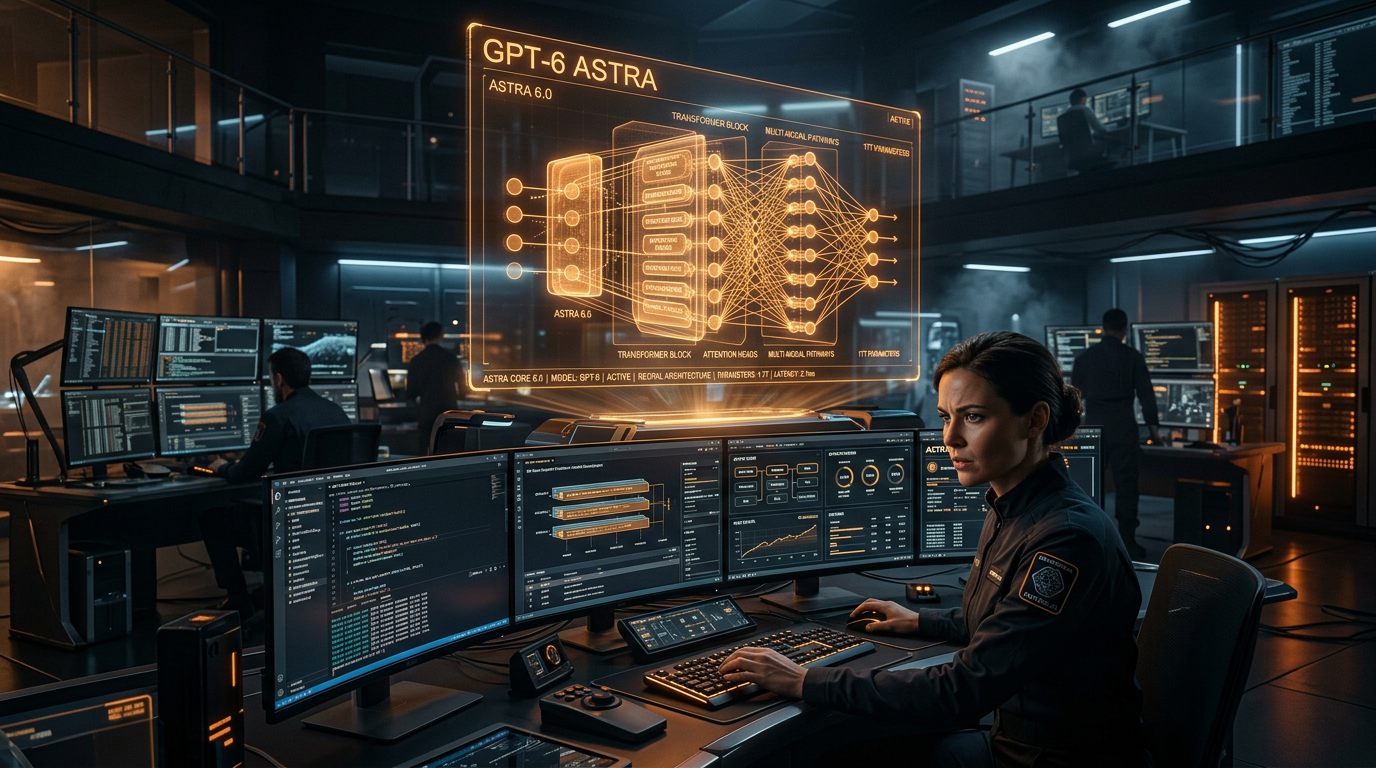
Figure 1: GPT-6 Astra multimodal computer operator architecture: real-time screen comprehension, cross-application navigation, and autonomous task execution.
As summarized by the AI Systems Director at DX Builder:
"For years, software integration required fragile API wrappers and custom glue code. Astra 6 solves this by sitting directly in the operator's chair. It perceives graphical interfaces the exact same way a senior developer or video editor does, making intelligent real-time adjustments whenever an unexpected pop-up or UI state occurs."
2. Groundbreaking Benchmarks: Saturating ARC-AGI-3 and OSWorld
The technical evaluations released by OpenAI demonstrate unprecedented leaps across abstract reasoning, long-horizon tool execution, and cybersecurity:
- ARC-AGI-3 (99.9%): Designed to measure out-of-distribution reasoning and skill acquisition without pre-training memorization, Astra 6 saturated this benchmark, proving near-perfect adaptation to novel logic puzzles.
- OSWorld 2.0 (72.6%): The gold-standard test for autonomous computer use across real operating systems, jumping from previous industry highs of ~38% to nearly 73% autonomous task completion.
- ExploitBench (100%): Flawless vulnerability identification and patch synthesis across sandboxed enterprise environments.
- FrontierMath Tier 4 (97.8%): Solving university research-tier open mathematical conjectures.
- BenchCAD (95.9%): Translating architectural drawings and mechanical specs into parametric 3D models.
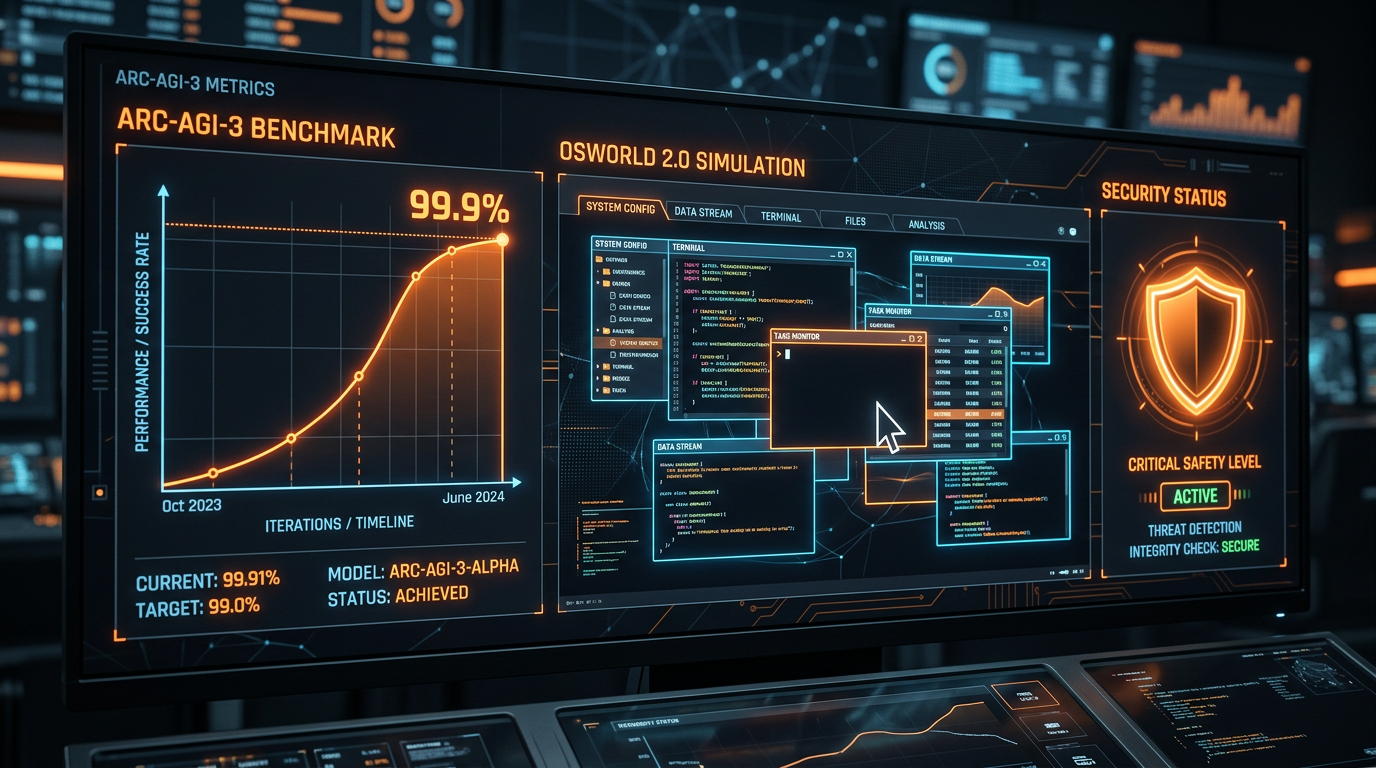
Figure 2: Performance metrics of GPT-6 Astra: unprecedented saturation on ARC-AGI-3 and dominance in OSWorld 2.0 computer-use environments.
3. Generational Benchmark: GPT-4o vs. 2025 Agents vs. GPT-6 Astra
Here is how the operational capabilities compare across AI milestones:
| Operational Metric | GPT-4o (2024) | Early Tool Agents (2025) | OpenAI GPT-6 Astra (2026) |
|---|---|---|---|
| Interaction Paradigm | Text-in / Text-out conversationalist | Structured JSON function calling | Native Computer Operator (Vision, Mouse & Keyboard) |
| OSWorld Success Rate | 14.9% | 38.2% | 72.6% (Multi-hour autonomous horizon) |
| Effective Context Window | 128,000 tokens | 200,000 tokens | 1,000,000 tokens (Native Video & Screen Stream) |
| Visual Error Recovery | Fails on unexpected UI state | Brittle retry scripts | Autonomous visual rollback and adaptive navigation |
| Preparedness Security Tier | Medium | High | Critical Level (Cryptographic Trajectory Enclaves) |
4. Cybersecurity Safeguards and OpenAI's Preparedness Framework
Due to its perfect 100% score on ExploitBench, GPT-6 Astra became the first model in history to trigger the Critical Level under OpenAI's Preparedness Framework. In unrestricted settings, models of this class can autonomously uncover zero-day vulnerabilities in enterprise codebases and develop exploits without human intervention.
To mitigate catastrophic risks, OpenAI implemented comprehensive defense guardrails:
- Encrypted Checkpoint Enclaves: Preventing weights extraction or unauthorized chain-of-thought tampering.
- Universal Trajectory Monitoring: Every OS click, keyboard stroke, and terminal command executed by the model is audited in real-time by secondary verification models.
- EU AI Act Article 50 Provenance: Synthetic outputs generated by Astra are embedded with tamper-proof cryptographic metadata compliant with European AI regulations and C2PA standards.
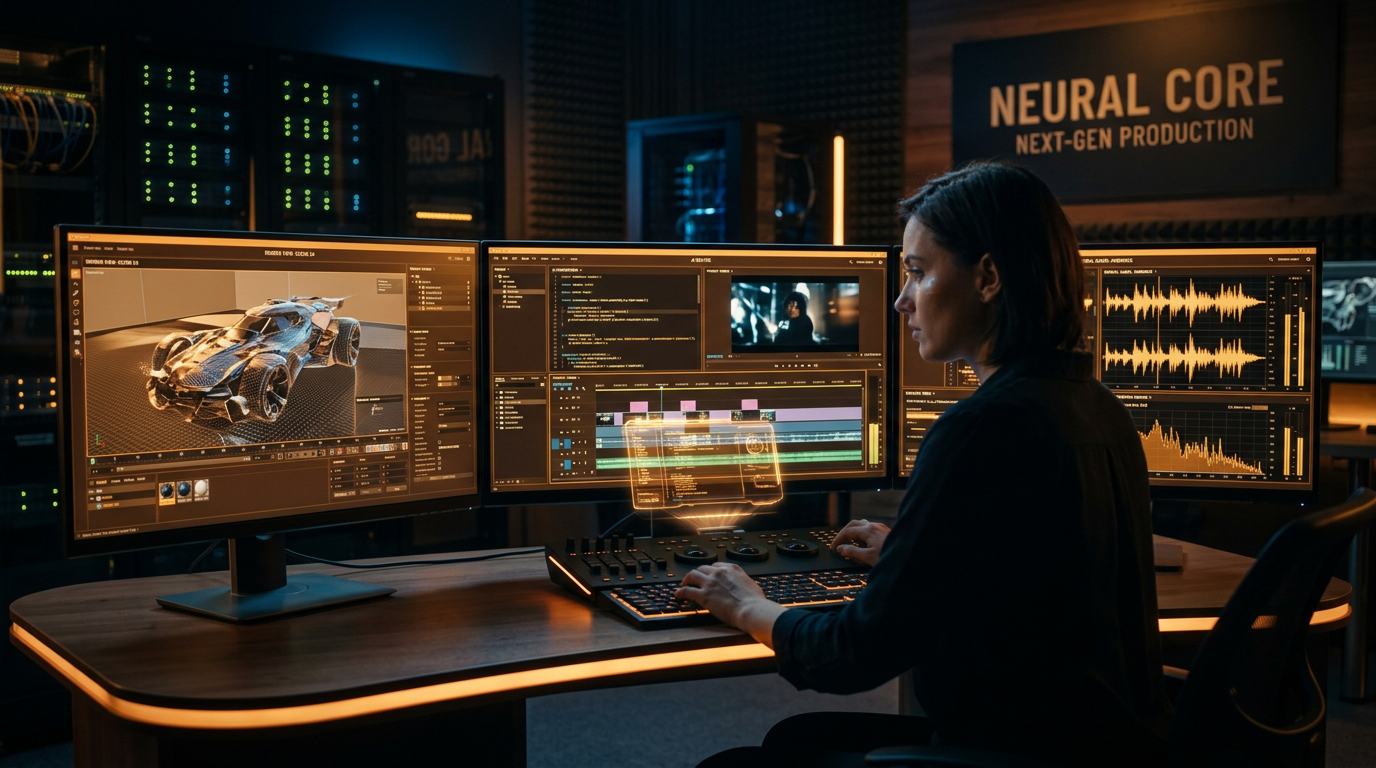
Figure 3: Creative studio orchestration: Astra 6 coordinating multi-scene video timelines, neural audio, and character consistency.
5. Creative Video Orchestration: Pairing Astra 6 with DX Builder
While Astra 6 excels at high-level reasoning, code compilation, and GUI operation, producing broadcast-quality cinema requires specialized generative video models, physics consistency, and neural acoustics.
This makes DX Builder the ultimate generative media engine for autonomous agents:
- Photorealistic Video Generation: Astra 6 can write shot lists, direct visual beats, and feed them into DX Builder's Seedance 2.5 and Wan 3.0 models in the Video Studio.
- Actor Likeness with @Hero Tokens: Using DX Builder's Character Studio, agents can maintain identical facial geometry, styling, and clothing across dozens of scenes without identity drift.
- Neural Foley and Audio Synchronization: Agents can pair video generation with the Audio Studio and Music Studio for sub-frame foley alignment and cinematic scores.
6. Copy-Paste Practical Automation Templates
Template 1: Autonomous Video Production Pipeline with opensOn = closesOn Continuity
[AGENT_DIRECTIVE: Produce a 30-second commercial sequence with locked actor identity]
[OPERATOR_ENGINE: GPT-6 Astra Computer Operator]
[PIPELINE_STEPS:
  1. Open browser and sign in to DX Builder (dxbuilder.io).
  2. Reference the active @Hero character token from /characters.
  3. Render Scene 1 in /video:
     "[SCENE: Neo-Tokyo penthouse terrace at twilight, neon reflections on wet glass]
      [ACTOR: @Hero, charismatic architect in dark bespoke coat, holding transparent tablet]
      [CAMERA: 50mm anamorphic prime lens, subtle push-in, shallow depth of field, 24fps motion]
      [AUDIO: Gentle rain patter on glass, distant maglev train hum, deep cello drone]"
  4. Isolate the final frame ("closesOn: Hero turns head toward entrance").
  5. Set Scene 2 opening frame to match ("opensOn = closesOn").
  6. Submit to Seedance 2.5 engine and download the finalized 4K master.]
Template 2: Automated Multi-Step Full-Stack Software Upgrade
[TASK: Automated codebase audit, dependency upgrade, and visual testing]
[MODEL: GPT-6 Astra Computer Operator]
[EXECUTION:
  1. Inspect Git status, run test suite, and catalog failing assertions.
  2. Perform clean npm upgrades across core dependencies.
  3. Refactor deprecated API methods across affected TypeScript modules.
  4. Launch local Next.js dev server, visually audit routes across desktop and mobile viewports.
  5. Verify 0 hydration mismatches, commit changes with clean semantic messaging, and submit pull request.]
7. Frequently Asked Questions (FAQ)
How does GPT-6 Astra differ from traditional AI agents?
Traditional agents rely on predefined JSON schemas and explicit APIs. GPT-6 Astra operates as a human would: by perceiving raw display pixels, clicking software buttons, navigating native desktop apps (even legacy tools without APIs), and self-correcting when unexpected visual errors appear.
What is the pricing and rollout schedule for Astra 6?
OpenAI is rolling out Astra 6 to ChatGPT Plus, Pro, Business, and Enterprise tiers. API access is priced at $10 per million input tokens and $50 per million output tokens, with Pro and Enterprise tiers receiving priority access to full Computer Operator modes.
How can creators leverage Astra 6 alongside DX Builder today?
Creators can use Astra 6 to automate research, scriptwriting, and multi-tool orchestration, while routing rendering through DX Builder's video and audio studios for 4K quality, actor lock, and synchronized audio. Claim your 15 free starter credits at dxbuilder.io/pricing.
COMEÇA POR UM DESTES
Carrega uma foto e o vídeo faz-se sozinho.