The Rise of World Models and Spatial AI in Generative Video (2026): From 2D Pixel Diffusion to 3D Physical Simulation with World Labs Atlas, Wan 3.0 & Seedance 2.5
Written by Video Director at DX Builder • Updated September 3, 2026
Executive Summary / TL;DR (BLUF for Filmmakers, Creative Agencies & AI Engineers): In early September 2026, generative AI video crossed its most crucial technological threshold since the advent of diffusion: the definitive shift from 2D pixel interpolation to World Models and Spatial Intelligence. Sparked by World Labs' public unveiling of the Atlas omni-modal model (founded by AI visionary Fei-Fei Li) and accelerated by state-of-the-art architectures like Seedance 2.5 IR2V and Wan 3.0, video generation is no longer flat surface guesswork. It is now a volumetric 3D physics simulation governed by explicit camera trajectory coordinates (X, Y, Z). Creators clinging to basic 2D text prompts suffer from perspective melting and anatomy warping. At the DX Builder Video Studio, through the Story Lab and PRO 3D Camera Presets, filmmakers orchestrate seamless cinematic sequence shots with physical object permanence at 90% lower production costs than legacy VFX pipelines.
1. What Are World Models and Spatial AI in 2026 Video Generation?
A World Model in generative AI video is an autoregressive and diffusion-based neural system that constructs an explicit internal 3D geometric representation of environments, materials, and spatial relationships before rendering any pixels to the screen.
Unlike 2023-2024 text-to-video generators that predicted consecutive 2D frames via surface pattern matching, a World Model inherently respects object permanence (an object does not vanish or morph when moving off-camera), optical lens parallax, and mass-based collision physics.
As stated by the DX Builder Video Director:
"The number one pain point for directors in 2024 was pixel melting. Any rapid camera crane or orbital sweep caused faces to warp and background geometry to dissolve. With the arrival of World Models and Spatial AI in September 2026, camera motion is no longer a textual gamble: it is a precise mathematical trajectory with focal depth, physical mass, and stable world space."
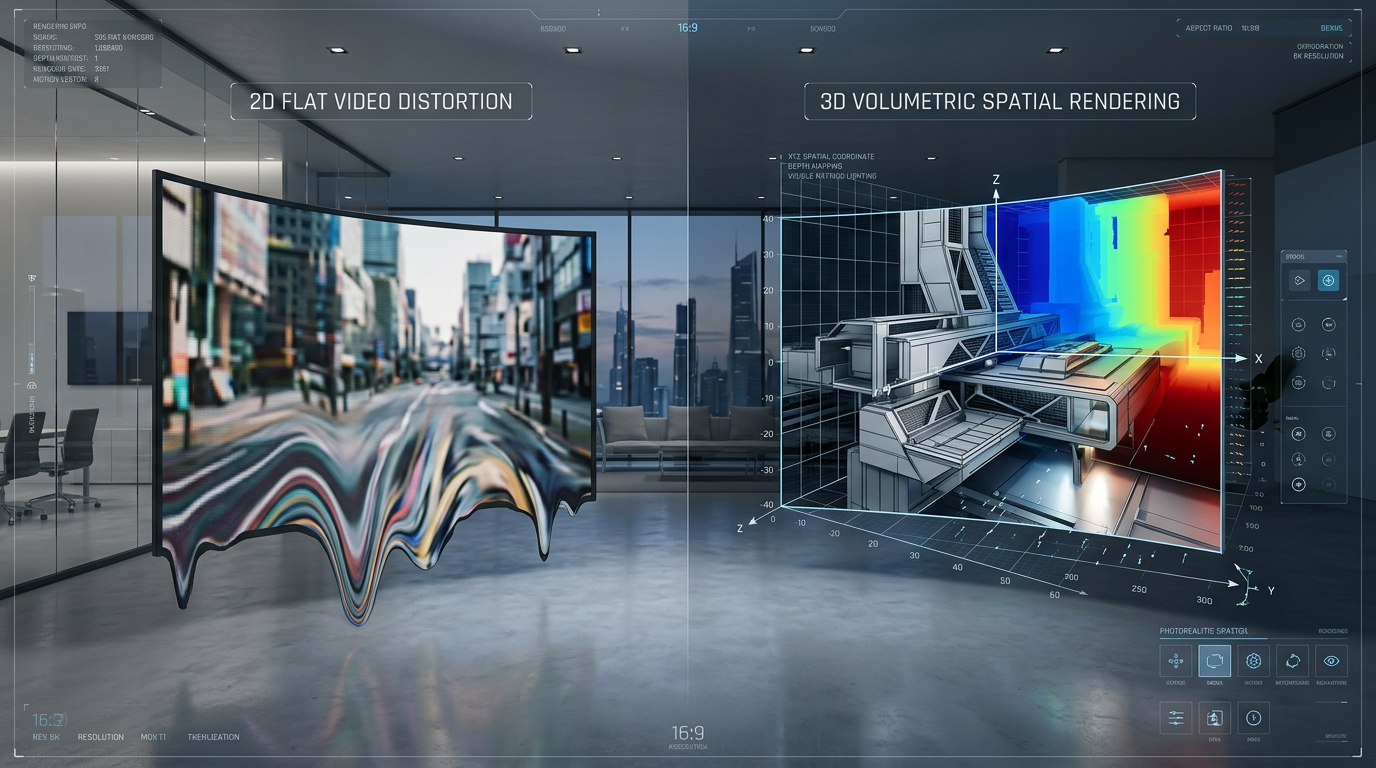
Figure 1: The Spatial AI breakthrough: From flat 2D frame interpolation to volumetric 3D coordinate-driven physical simulation.
2. Benchmark: 2D Video Diffusion vs. 2026 World Models
For commercial directors and VFX supervisors, this architectural shift changes the economic reality of high-end production:
| Capability | 2D Text-to-Video (2023-2024) | 2.5D Multimodal (2025) | World Models & DX Builder (2026) |
|---|---|---|---|
| Spatial Geometry | Zero (2D statistical illusion) | Approximate depth maps | Native 3D (XYZ coordinates, true parallax) |
| Object Permanence | Collapses on 180° camera turns | Partial stability via anchor tokens | Absolute (objects persist off-screen) |
| Camera Control | Vague textual hints ("pan left") | 2D motion brush guides | Robotic vector paths (Orbit, Dolly, Crane, FPV) |
| Identity Consistency (@Hero) | Melts after 3 seconds | Frontal likeness locked | Full 360° volumetric identity sheet |
| Render Latency per Scene | 60s - 120s (720p unstable) | 45s - 90s (1080p upscaled) | 25s - 40s (Native 4K with Seedance 2.5 / Wan 3.0) |
| Cost per Usable Second | $0.80 - $2.50 (90% reject rate) | $0.30 - $0.70 (50% yield) | < $0.05 with 95% first-take usability |
3. The 4 Pillars of Spatial Cinematic Production in 2026
To master high-retention video production inside DX Builder, creators utilize four core spatial principles:
- 1. Explicit Trajectory & Optical Calibration: Instead of generic buzzwords, modern engines parse precise camera coordinate vectors (e.g.
[CAMERA: 35mm anamorphic, dolly-in along Z-axis at 1.2 m/s, slight pedestal tilt up +12°]), ensuring focal depth of field and anamorphic bokeh behave realistically. - 2. Volumetric Character Consistency (@Hero Lock): Using the Character Studio, DX Builder establishes 3D facial geometry across reference poses, allowing the camera to orbit 360 degrees around your actor without identity degradation.
- 3. Photorealistic Physical Material Interaction: World Models natively compute index of refraction, specular light scattering, and fluid dynamics, making luxury watch, automotive, and beverage commercials look indistinguishable from real studio cinematography using our PRO Presets.
- 4. Seamless Scene Handoff in Story Lab: Maintaining narrative continuity across consecutive shots is solved by our strict
opensOn = closesOnrule in Story Lab, ensuring light vectors and actor positions seamlessly pass from Shot A into Shot B.
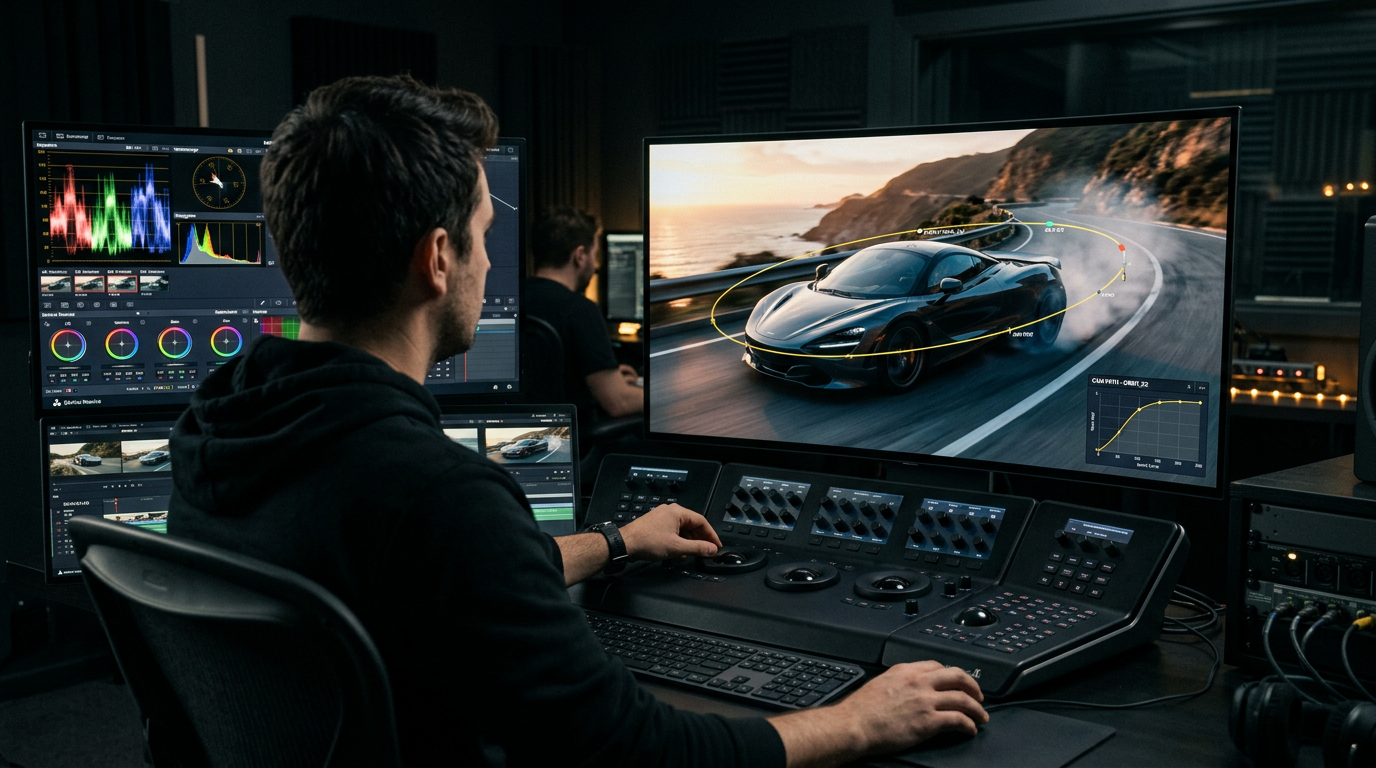
Figure 2: Next-gen AI grading suite: 3D orbital camera trajectory control applied to high-end commercial automotive video.
4. Ready-to-Use Spatial Prompt Templates
Copy and test these production-ready prompts calibrated for Seedance 2.5 and Wan 3.0 inside the DX Builder Video Studio:
Template 1: 3D Volumetric Orbital Sweep (Luxury Commercial)
[SPATIAL_TRAJECTORY]: 360-degree continuous clockwise orbital tracking shot around matte-black electric hypercar parked on wet midnight asphalt.
[CAMERA_OPTICS]: 50mm T1.5 prime lens, constant radius r=4.2m, height h=1.1m from ground, silky smooth robotic arm motion with zero jitter.
[LIGHTING_PHYSICS]: Wet asphalt reflections perfectly responding to sweeping volumetric stadium floodlights, sharp specular chrome highlights, dynamic lens flare anamorphic horizontal streak.
[SCENE_GEOMETRY]: Static physical environment, persistent architecture with brutalist concrete pillars, rain droplets bouncing with physical mass.
[AUDIO]: Synchronized deep low-end engine hum, atmospheric drizzle, soft tire surface grip, no music dialogue.
Template 2: Architectural FPV Dolly-Through
[SPATIAL_TRAJECTORY]: Smooth forward linear dolly-in along main architectural axis Z at walking pace (0.8 m/s), passing through double glass sliding doors onto cantilevered cliffside terrace.
[CAMERA_OPTICS]: 24mm ultra-wide f/2.8 lens, horizon locked level, continuous smooth elevation change descending 20cm at the threshold.
[LIGHTING_PHYSICS]: Golden hour sunset illumination, warm bounce light on polished microcement flooring transitioning to direct warm sunlight on infinity pool surface.
[OBJECT_PERMANENCE]: Interior designer sofa and marble kitchen island maintain absolute volumetric dimensions without edge warping during camera transit.
[AUDIO]: Subtle indoor air conditioning transitioning to open air ocean breeze and distant gentle wave breaks.
5. Ethical Compliance, C2PA Provenance & Global Regulations (EU AI Act)
With Article 50 of the EU AI Act taking full legal effect in August 2026, content transparency is mandatory for commercial distribution.
Every video rendered on DX Builder adheres strictly to the cryptographic standards of the C2PA (Coalition for Content Provenance and Authenticity) and W3C, embedding tamper-evident provenance metadata to guarantee safe deployment across YouTube, Meta Ads, TikTok Shop, and broadcast television.
6. Frequently Asked Questions (FAQ)
What is the core difference between a World Model and standard video diffusion?
Standard diffusion models predict 2D pixels frame-by-frame based on training imagery patterns, which inevitably leads to melting geometry when the camera moves. A World Model first establishes a persistent 3D spatial simulation of geometry, depth, and lighting, rendering the video as a virtual camera moving through a coherent world.
Do I need 3D animation or CGI skills to use spatial camera trajectories in DX Builder?
Not at all. In our Video Studio or V2 Presets, you simply pick your preferred camera motion or write standard optical descriptors. Our neural compiler automatically translates your request into the spatial trajectory vectors understood by Seedance 2.5 and Wan 3.0.
How do I start creating with 3D camera consistency right now?
Sign up at DX Builder to immediately receive 15 free welcome credits. Explore our Video Studio, or choose a production tier on our pricing page for scalable commercial workflows.
Compare before creating
Explore differences, costs and limitations to choose the right tool.
COMEÇA POR UM DESTES
Carrega uma foto e o vídeo faz-se sozinho.